This page holds the current week; older weeks are linked at the bottom.
2026-09-18 · 123 items
Headlines
- The title screen freeze is fixed. Two sessions on build 262 spent 836 and 717 seconds frozen before reaching a character, and the files behind it now load during boot instead.
- The Oracle now answers single players who are offline. The help window, the knowledge base links and bug reporting all work without a shard, and a machine with no internet is told that is what is missing.
- The Next Steps panel now teaches as well as advises. Seven help topics ship with written guidance that nothing in the game ever triggers, so nobody has read them. It offers one at a time, opens it when you click, and moves on to the next.
- Farming experience is back to what it paid before. Two separate changes had each roughly halved it: sowing settled at 25 experience a seed instead of 50, and planters standing against another object stopped growing and refused water, which harvested them at a quarter rate.
- The Rough Wooden Lamp Post and 42 other decorations whose collision starts above their base place on lot ground again. The support check now also looks under the point the item was set down on; streetlamps, standing stones, snowmen, scarecrows, telescopes and most Epic trees were all being refused as floating.
- Castle Atos is enterable again after an unused development lot outside the gate was removed. The town had been refusing every join, leaving players on a loading screen that never finished.
- Night Vision finally rewards training: the spell lights about 60 metres untrained and 100 metres at skill 200, instead of brightening the entire map by the same amount at every level.
- Pet Every Dog! A hidden achievement over the fourteen named dogs of the world, and the /pet emote works for everyone at last.
- Vitium's Crown. The leader of the Cabal drops a black spiked crown you can wear in your head slot, or set down on a lot as a decoration. It is artifact-grade, so it survives a ransom and never loses durability.
- Indigno stopped throwing you across the room once a second. The curse now fires at most every three seconds, and a hazard whose effect leaves nothing behind keeps its own interval instead of firing on every pulse.
- Cabalists now shout across the whole siege: a kill taunt that names the player who fell, and a death cry the entire zone hears.
- Vitium fights back in three stages now: he pulls the siege dark over the stronghold at three quarters health, calls four dead Cabalists back to their thrones at a half, and throws everyone at the throne across the map at a quarter.
The Herald
- The New Britannia Herald for 2026-09-17 is up: Offline single player is playable again, and it no longer asks for an account, a password or an internet connection. The Mac client had been shipping a second copy of the whole game since the fifteenth of September, and four new checks now stand between a build and that mistake. Player vendors speak for the first time, the Oracle learned which shopkeeper in which town stocks what you want, and buy orders on a player vendor can be filled a few at a time. Listen or read the transcript (17 min). Subscribe in any podcast app: /blog/podcast.xml
Tools
- The bugfix loop now recognises a driver running under a dotnet-installed PowerShell as a live lock holder. On the Mac, where pwsh has been a dotnet global tool since 2026-09-14, all four sharded drivers of this morning's run read as stale locks while they were working, and a second start on the same shard would have claimed over them. The guard tests cover the case.
Community
- Filed a tracker bug for a quest HUD tracker that stays visible for "Open Chest, Loot Gate Key" after the step completes (nightly forum sweep, reported by Morgathys).
Content
- Fixed a duplicate name in the Chinese Light Armor tree: the second skill on the first row used to read the same name as the first skill. It now reads the wording its own tooltip already used.
- The rowboat east of the Brittany galleon dock on the Novia world map said Ferry to Spindrift Island, a place that does not exist; it crosses to the island that holds Elad's Lighthouse. It now reads Ferry to Elad's Lighthouse, and both ferries have compass and map markers for the first time. Leaving Central Brittany or standing at the galleon dock marks the crossing alongside the lighthouse you can already see across the water, and leaving the town on the island marks the boat back. Every other rowboat on the map borrows the marker of the town it lands at; these two were 60 m from anything.
- The /pet emote now works for every character. It had been authored, animated and reachable by typing /pet for years, but it sat behind a deed that could not be taught or bought, so for almost every player /pet did nothing and reported nothing. Petting now also turns your avatar toward whatever you have selected.
- Three named dogs changed. Mylo in Castle Atos had been switched off under a note warning not to activate him while a lot sits in the courtyard. The lot is there and he stood inside its footprint, so he is on now and moved clear of the edge onto ground the navmesh already covers. Cheyenne and Zoey in the Brittany graveyard were still wild animals you could attack, and are friendly now like every other named town dog.
- Vitium's Crown is in, and it is wearable. The leader of the Cabal now drops a black spiked crown that goes in your head slot, and it can be set down on a lot as a decoration instead. It is artifact-grade, so it is protected from ransom and takes no durability loss.
Client
- Fixed a case where a nameplate whose name label had no font threw a string of errors and stopped whatever was placing the plate. The label now keeps drawing (unsized) and the client keeps going. Requested through the morning crash pass on the client logs.
- Conversations with the Oracle are now saved to a text file on the player's own machine, in a new OracleLogs folder in the game data folder, one file per day. Questions, answers, cited knowledge base links and the number of any report the Oracle filed all go in, timestamped, written as the conversation happens rather than at exit, so closing the client or a crash keeps what was already said. Requested by Darkline, who reported that closing the client lost the conversation.
- Fixed a long-standing problem where the game taught each installation rather than each character. Every one-shot help window was remembered once per machine, so a second character walked through the same first hour in silence. Each character keeps its own record now. Existing characters inherit what they had already seen, so nobody is taught the opening again, but a new character finally gets the help it was always meant to.
- Offline play now reads the account's own access flags for the developer, GM and tester tools, the same way online play does. Offline needs no account, so those tools stay closed there; the Unity Editor keeps its bypass so the tools can still be worked on without a login.
Perforce migration
- Wrote down what each of the 49 held-back scene changelists actually did. Reading one is not a matter of looking at the diff: two revisions of Castle Atos differ by 2.4 million lines, and the edit is invisible in them anyway, because a blocker volume is stored as a prefab instance rather than as a scene object. Three small readers now recover the position, rotation and scale of all 130 blockers, checked in alongside the list.
Combat
- Fixed a stealth stacking exploit: casting Cocoon of Night on top of Shadow Form, Silent Movement or Vanish (or the reverse) used to leave both stealth icons up and add the two stealth percentages together. A fresh stealth glyph now replaces the one you were already carrying, the way the other four stealth glyphs already replaced each other.
- Immolations flames come back after a scene change. The buff kept the same duration through a zone-in, but the fire visual on the character was lost until the buff was cancelled and recast; it now redraws on the far side and burns until the buff itself ends. Testing task #7861.
- Fixed an aiming failure in cramped interiors. The reticle picks its target by sweeping a sphere out from the camera, and a collider the sweep already started inside came back at zero distance and was taken as the target. Nothing nearer could replace it after that, so an enemy standing two paces away could not be aimed at. Reported from the ruined steeple in Highvale Outskirts, where a pair of Frostgeists made it easy to run into.
- Pressing the next-target key right after a kill could throw out of the targeting update for that frame. The candidate list was read one line before it was checked for an entry that had already been destroyed, and something dying is exactly when that happens. The check now runs first.
- Added a diagnostic behind the "Invalid target." message. Four separate refusals in the glyph cast check share that one sentence, so a player report of it never said which had fired. The client log now names the gate, the glyph, and the state of the target the cast actually resolved.
- Settled the question of whether the next-target key should pick up neutral creatures the way a clicked glyph target does. It stays on hostile creatures only, so deer, farm animals and other neutral creatures remain click-to-select and never enter a fight's cycle. The reason is now written at the filter and a test pins the decision.
- Night Vision now has a reach that grows with the skill. The spell used to raise the ambient light across the whole scene, so a hilltop a kilometre away brightened exactly as much as the ground at your feet and a character at level 1 saw the same picture as one at 200. A depth pass now takes that extra light back out past a distance training buys: about 60 metres untrained, 100 metres at skill 200, and a metre for every ten points of Lunar Mastery. The sky, the moon and the stars are left alone.
- The Cabalist Indigno carries a curse that throws anyone nearby five to fifteen metres in a random direction. It was firing about once a second, so a fight with him was mostly being shoved around, and you could be thrown while standing well away and not fighting at all. It now fires at most once every three seconds and only rolls one time in four, so a throw lands about every twelve seconds. The throw itself is unchanged.
- The curse was authored to fire on a ten-second interval and never got one. A hazard area holds a per-target lockout so it does not re-apply the same effect over and over, and that lockout is released the moment the effect is gone from the target, which is what lets lava burn you again after you put yourself out. A teleport leaves nothing behind, so the lockout was released on every pulse. A rune that has never once been seen on a target now keeps its own interval, behind a live switch, and the fields the rest of the game uses are unaffected. Two regression tests, where there were none.
Tooling
- New commit check: a rename that strands a fix. When a file is renamed on one side and fixed on the other, the rename can land the unfixed copy at the new name and leave the fixed one behind without its metadata, which is how 22 decorating surfaces nearly went back to being invisible walls. The check refuses that commit on both commit paths.
Client
- Fixed a rare client fault that wiped every name off the screen. When the client came up without a face to draw names with, it threw an error for every nameplate it tried to build, 184 of them in 22 minutes on one build 262 session. Sixty-four of those came from the decoration loader, so decorations were being abandoned part-placed as well. The client now falls back to a spare face, and the name-sizing step stands aside instead of failing.
- The Oracle's read of what a character still has open, meaning their active tasks, the towns they have never visited and the quests they have not started, moved out of the Oracle and into a shared piece of code. It answers exactly what it answered before. The reason for moving it is a new on-screen Next Steps panel now being built, which needs the same read and would otherwise have carried a second copy of it.
- Pressing Play could freeze the client at the title screen. Nine sessions on build 262 logged 31 recovered stalls, the two worst adding up to 836 and 717 seconds of frozen window before the player reached a character, and one machine filed three hang reports in a single evening.
- The cause was a handful of data and art files loaded the blocking way at the moment the game was already loading the player character in the background. A blocking load waits for whatever the engine has pending, so a small file could bill 293 seconds. Four of them now load during boot, where nothing else is in flight, and the later read finds them already in memory.
- The loading screen background and the potion and food catalog could not be made resident, so they moved off the blocking path instead. The catalog was also being loaded twice a session, once at startup and again when the character sheet arrived, which is why the same file showed up on stall reports from both points.
- The stall telemetry had been blind to this the whole time. The big background request the title screen waits on was never counted, so every collision reported nothing in flight, and the collision log stopped before the player had even pressed Play. Both now cover the title screen, so the next slow boot says what it was waiting for.
- Raised the GPU instancing batch cap on the Port_Standard and Port_Standard_Specular shaders from 32 to 64 instances, in both the shadow and deferred passes. The per-instance property buffer is 848 bytes wide, so a 64 KB constant buffer holds about 77 of them and the old cap was using 41 percent of the space. Whether that cuts draw batches in a decorated town depends on how often batches reach 32 in the first place, which the decoration benchmark measures next.
Crafting
- A safety net now stops one broken entry in the master recipe list from wiping every recipe in the game. The build pipeline already scrubbed dead entries out before shipping, so nothing was ever visibly wrong for players; the change is defence in depth for the day a bad list slipped through.
- The recipe book now puts as many recipes on a page as the page has room for. It showed two per facing page whatever size the window was, a number inherited from the old book, whose pages had four fixed recipe slots. The new pages are scroll columns that stretch to the window, so at the default size a page had room for three and used two. Pages are packed to their measured height now, the split between the facing pages falls wherever the recipes stopped fitting rather than down the middle, and resizing the book repages it and keeps you on the recipe you were reading. Reported in-game by Astirian.
Housing
- Planned a house flip: mirroring a player house on its left-right axis as a fourth component of the house pose, so the door and window arrangement can sit on the other hand. A prototype settled the two mechanisms that usually make mirroring expensive - the pathfinder already handles mirrored geometry when it bakes a house, and player houses carry no baked lighting to invalidate. The catalog is 197 houses, and a flip in place turns out to be legal for all of them, including the 66 whose footprints overhang the lot line and can never be moved.
- Houses can now be flipped left-to-right. The pose that lets an owner slide and turn their house on its lot gained a fourth component, so the door and window arrangement can sit on the other hand. It reaches all 197 houses rather than the nine hand-mirrored rowhouses that existed before, and a flip answers to a shorter set of rules than a move: mirroring in place needs none of the room a slide needs, so houseboats and galleons on water lots can be flipped even though they can never be moved. A house has to be empty to flip it - the furniture does not come along, and the alternative was mirroring the lettering on everyone's bookshelves. Still switched off while the mirrored navigation is baked for the catalog.
- Baked the mirrored navigation for all 197 player houses, so a flipped house has a floor its pets and vendors can walk. Checked every pair by measuring both graphs: the mirrored one differs from its twin by 1.79% of area on average, which is the voxel grid the navigation is built on not being symmetric itself. Six houses fell outside that, and in four of them it is the ORIGINAL graph that is wrong rather than the mirror - the red barn measures 68 metres across in its old bake and 18 in the new one. Those are the same stale bakes that already keep those houses from being moved.
- Drove a flipped house in play mode. Collision mirrors exactly, all fifteen doors come through intact, and a worry about furniture snapping to walls turned out not to apply at all - no player house authors snap points, so that code never runs on one. A reported problem with distant detail not being hidden on a flipped house was CHECKED AGAIN AND WITHDRAWN: the measurement behind it was reading a flag Unity does not use for that decision, and the one sound comparison shows a flipped house and a normal one behaving identically at every distance tested. Nothing was changed for it.
- Swept the whole house catalog for lettering that would read backwards on a flipped house. No house renders live text at all, and of the twelve carrying anything sign-like, the airship logo is symmetric, the wood plaque is blank, the archway carvings are knotwork and the heraldry banner is an empty dye mask. Nothing needs excluding. One thing noted for later: five ships take their heraldry from a guild image at runtime, and a guild device that is not symmetric would read backwards on a flipped ship.
- Free house placement and house flipping are switched on for the QA shard for internal testing; build 264 carries both halves. The Tunables page catalog gained the housing.flipEnabled row it was missing (a save from the page would have been refused as an unknown key), and the QA runbook now records how a tunable is set on that shard by hand, since it has no Tunables page of its own.
- The reset-position test fixture had been red since the morning flip-switch commit: it counted the gates a reset skips and expected two, and the flip switch added a wanted third (a reset un-flips a house even while flipping is off). Re-pinned at three and renamed to say so. Fixture only, no player-visible change.
- Yard decorations now block a house move or Reset Position by their whole shape rather than the single point they were placed at. gravidy found the gap on the last pass: a deco placed where a wall used to stand, pivot a hand's width outside the line, and the reset put the house back with the deco inside the wall. The server cannot see a prefab, so an Editor bake now measures every item archetype's decoration prefab once into a footprint table compiled into both client and server, 15,997 rows from 9,059 prefabs on the first pass. The gate rotates the item's box by its full stored rotation (a rug tipped flat measures flat), ignores a 10 cm slack, and refuses only when the overlap is deeper than at the current pose; an item the house already covers still never blocks. The refusal names and tints the item as before, and /verbose housing prints the first blocker's footprint and overlap. Also fixed: the reset pre-check on a mirrored house tested the flipped rect while the server tests the authored one. Verify task #7922.
Crafting
- Put the recipe list back in step after the Perforce import. Four recipes retired with the Quartermasters Cutlass cleanup were still listed, and two new ones, the Small Canvas Bag and the Pew, were not listed at all. The list is generated and a build rebuilds it, so no shipped build was affected, but the committed copy was describing a game that no longer existed.
Quests
- Reading a character's quest state used to change it. Asking whether a task was available could expire a daily or weekly flag, write that expiry to the server, and restart the scene routing work as a side effect of the question. There is now a way to ask that describes without changing, and the shared progress read uses it. The same read also stopped answering before a character's flags have finished loading, where it would have offered quests the player finished long ago.
- Every quest in the game carries a written line telling you where to go and who to speak to, and the only way to read it has been to open your journal and find the task. The Next Steps panel shows it now, under the task the tracker already names. Quests you can get on with where you are standing come first, and one that continues somewhere else says where, as long as there is a single place to name.
- Fixed the inventory tutorial task Open Chest, Loot Gate Key staying on the on-screen task list after it was done. Its completion condition was the one journal entry out of 909 written as a comma list instead of the pipe form the expression parser reads, so the zone-change sweep that retires finished tasks read it as a single flag nothing ever sets. The on-screen task list now also refreshes on every quest-flag change, so it cannot drift from the Journal even if a task-ended event is lost. Three new EditMode fences: the entry itself, every completion expression in the file, and the tracker wiring.
- Fixed the inventory tutorial adding a Loot Gate Key task after the gate key was already in the bag (#7887; Take Chest Key did the same at the first chest). The chest writes that journal entry when its loot window closes, and the key is taken inside that window, so the entry arrived with its completion flag already set and sat on the task list until the next lock or zone change. A task journal entry is now checked against the knowledge flags when it is written: one whose condition already holds goes into the Journal finished, raises no task-began event, and its chat hint is skipped. The zone-change sweep already retired such entries on the next scene load; this does the same call at write time, for every place that writes a journal entry. Two new EditMode fences: the write-time rule and its wiring, and the two tutorial entries evaluated with the real parser.
Interface
- Work started on a Next Steps panel, an on-screen list of things your character could usefully do right now, meant to sit alongside the quest tracker and be turned off if you do not want it. The part that decides which few suggestions earn the space landed first: urgent things outrank convenient ones, one topic cannot take over the list, the order holds still between refreshes, and putting a row away keeps a count of what you hid.
- First three advisors for the Next Steps panel: carried weight, unspent experience, and whether a place suits your level. Most of the work went into when they stay quiet. A pack carried somewhere the weight penalty does not apply says nothing instead of claiming you are slowed, experience with nowhere left to spend it says nothing instead of sending you to a window that cannot help, and towns say nothing about danger at all.
- The Next Steps rows can speak now. The advisors deliberately return no words at all, only a judgement, a number and a name the game had already translated, so the sentence is composed in one place from a localized string and the panel works in all eight languages. A suggestion with no sentence yields no row rather than a placeholder, which means a new advisor that arrives without its wording is invisible instead of shouting English at everyone.
- The Next Steps panel draws now. It sits beside the quest tracker, holds up to four suggestions and a count of anything held back, moves where you put it and remembers, and says there is nothing pressing rather than showing an empty strip. Options has a Show Next Steps switch under Hints to turn it off. It rebuilds only when something that could change its answer actually happens, never on a timer.
- The scene data now has the shape it will ship in. A scene entry only answers if the scene file still matches what it was generated from, and a scene that has been edited since falls silent rather than stating something that used to be true. Not being able to check counts the same as a mismatch, so the guard does not depend on every caller handling an error correctly.
- The Next Steps panel can see the place you are standing in now, not just your character. Standing in Soltown it had one thing to say, spend your experience, in a town with forty-four quest chains and twenty-one people offering work. It now counts the work on offer you have not taken up, and the landmarks in a town you have not walked into yet, and it goes quiet about both once you have work in hand or have finished the town.
- The Next Steps panel can see what is around you now. In a town it will tell you a trainer there teaches something you qualify for, and whether you can afford it today or need to go and earn it first; which crafting stations are for crafts you actually know; and what is worth gathering nearby. The gathering row is loudest when you have the skill but no tool, because that is the case you would otherwise only discover by walking up to a node and being turned away without being told why.
- The Skills window Tree view now rules off the school groups in its left rail. Combat, Magic and Strategy were stacked two pixels apart and read as one column of sigils; each group below the first now sits under a centred hairline with eight pixels of space above and below it. The Crafting tab gets the same between Gathering, Refining and Production. Requested by Astirian.
- The Next Steps suggestions moved into the quest tracker rather than floating in a strip of their own. One list, one place to drag, one place to look. Your tracked tasks sit at the top as before and the suggestions hang underneath them.
- The Next Steps panel now teaches as well as advises. Seven help topics ship with written guidance that nothing in the game ever triggers, so no player has seen them. The panel offers one at a time, and clicking it opens that guide, which retires the row and brings up the next one.
- A Next Steps row that points at a window now names the key that opens it, read from your own bindings each time the row is drawn. Rebind the journal and the row follows. Where no single key opens the thing, the row leaves the clause off rather than guessing.
- Next Steps rows only take mouse clicks when they lead somewhere. A row that just reports passes clicks through to the world, the same way the gaps in the quest tracker do.
Documentation
- Wrote down what the Next Steps panel is allowed to say. The world map already decided how much a scene tells you about itself: that quests are available, not who has them, and which resources are there, not how many. The panel matches that rather than quietly saying more, and it will never take over the destination you set yourself or point at somewhere you have not found.
- Test-runner doc: how to run the file-reading EditMode fences with dotnet test while another session holds the Editor, including the small Application.dataPath shim that lets the quest and HUD fences resolve their files outside the engine.
- The Unity 6 upgrade plan and the build-health page record why the trees stood still for three months: a shader include the project carries multiplied the wind by a per-tree value the old engine supplied and the new one never does, and nothing flagged it because the shader still compiled. The note says how the missing value was proven (search the player binary for the name) so the next vendored include gets checked the same way.
Localization
- Caught up a backlog in the translation source database while adding the panel strings. 185 strings from other recent work had never been harvested into it, which is invisible twice over: the translators never see them and the coverage report never counts them, so the game reports 99 percent and shows English. Nothing was removed and the catalogue went from 8,044 entries to 8,241.
Content
- Built the first per-scene knowledge for the Next Steps panel, covering the three path openers and Soltown. It records what each trainer there actually teaches, which crafting stations a place holds, and which tool every harvestable type needs, none of which the running game can work out for itself. Two data problems turned up while building it: two quest props were borrowing the pine-wood type with the wrong tool, and five skills that five trainers still advertise do not exist in the game any more, so Soltown's adventuring trainer teaches 171 skills rather than 176.
- Added Ardoris to the Next Steps scene data: seven trainers, every one of the ten crafting stations, twenty-nine merchants, a bank, and forty-one landmarks you unlock by walking in. It is the first entry that tests the rules rather than just filling a table, since seven trainers in one city is exactly what the limit on how many rows one topic may take exists to handle.
- Added Owl's Head to the Next Steps scene data: four trainers, all ten crafting stations, twenty-nine merchants and twenty landmarks you unlock by walking in. Its heavy armour and focus trainers were the last schools missing, so across the six scenes recorded so far every school in the game now has a trainer somewhere in the data.
Creatures
- Fixed a decoration pet falling through a small gap in a floor. The game finds the ground under a creature by looking straight down from a single point, and a crack far too narrow for the pet to fit through is still wide enough for that one measurement to pass through, so the floor it found was the ground under the building. The pet was placed on it, snapped back up, walked over the crack again and repeated the whole thing indefinitely. It now checks around the pet's whole footprint before moving it down. Summoned creatures were hitting the same gaps and are fixed by the same change. Reported by Darkline.
Oracle
- The Oracle now answers in Single Player Offline. It used to reply "The Oracle can only be reached while you are online", and the toolbar help icon opened the game guide web page instead of the help window. Offline play means no shard rather than no internet, and the Oracle was never a shard feature, so the refusal was doing nothing but turning away the players with nobody else to ask.
- Offline asks needed their own identity. Offline play takes no login and every offline client reports the same user id, so all of them would have shared one hourly question limit. Each installation now uses a random id of its own with its own limit, the Oracle is told not to send an offline player to chat or to other players, and reports filed from offline play are marked as such for triage.
- Knowledge base links in an answer open inside the Oracle window offline, the Toggle Oracle Window keybind and the /oracle and /ask commands all reach the same window, and a machine with no internet connection is told that is the reason instead of being asked to try again in a moment.
UI
- Quit and exit confirmations are the size of their own text now. The question is centred, the window ends where the buttons do instead of leaving an empty band below them, and the close button sits in the top-right corner. A longer message, like the pending ransom warning, makes the window taller rather than being cut off at the bottom.
- The confirmation buttons (Quit, Exit, Leave Now, Cancel) were drawing at about two thirds height because they were missing the shared button style. They are full height again, and every window that cannot be resized got its close button moved back into the corner, not just the quit prompt.
- Turning chat timestamps on no longer puts a clock in front of an NPC's lines. Options > Interface > Chat & Conversation has carried Show Conversation Timestamps as its own row since the two settings were split, but the conversation row borrowed the chat answer until you ticked it, and it kept borrowing it, so switching chat timestamps on later moved dialogue with it. The borrowed answer is now recorded the first time the game reads it and the two rows move separately from then on. Nothing changes on screen for anyone: whatever you see today is what gets recorded. Requested by Astirian.
- The chat window's close button moved out of the window's own top-right resize corner. Hovering it showed the resize cursor, and a click a pixel off the button started a resize instead of closing the window. Every other window already kept its close button clear of that corner; chat's tab-line styling had overridden the padding that does it. The 12px comes out of the tab strip, which already hides tabs that no longer fit.
- The Journal window's Journal tab now lists your notes newest first. It was showing them oldest first, so on a character with a long history the note you had just picked up sat at the bottom of the scroll. Active Tasks and Completed Tasks keep the order they had.
- In the Skills window's Tree view, each ring of school icons now carries its group name as a heading above it. Combat, Magic and Strategy used to be printed in the middle of their own circles, in the same 12px white as the school names that fade in when you hover an icon, so on the Magic and Strategy rings the group name and the centre school's name sat a few pixels apart in identical type. The headings take the window's own heading style, cream with a rule under it, matching the trainer badge and the Specializations line above them. Reported from in game as issue 7871.
- The creature you have selected now always shows its buff and debuff icons under its floating name, whatever the Show Creature Effects setting says. That setting ships Off, so a rooted or mesmerized monster used to show the effect on the target frame at the top of the screen and nothing over its own head. Creatures you have not selected still follow the setting, and selecting another player still shows no icons under their name.
- The on-screen quest tracker and its Next Steps suggestions could draw over the login and character select screen, showing the tracker's move handle and the line Nothing pressing before any character was loaded. Both now only draw while you are in the world.
- The eight poison coating potions (Chaotic Corruption, Corpion, Corpion Aether, Deadly, Festering Death, Numbing, Paralyzing Spider Venom and Stinging) now show their own potion bottle on the Utility Hotbar and in the Combat Decks window, in both the Classic and Modern icon sets. Each bottle has its own liquid colour and a small charge beside it, on the same blue hexagon frame as Shadow Poison. Before, all eight drew the same skull and dagger shield, so a bar of poisons read as one potion eight times. Reported as #7759.
- Chat window no longer reopens itself during the Isle of Storms tutorial. Tutorial steps, journal notices and NPC status lines used to pop a closed chat window back open on every step; on the Isle they now leave it closed (the text still shows centre-screen and lands in the log), while whispers, party, GM and daily messages still open it. A machine playing Single Player Offline for the first time now starts with chat closed instead of open and pinned. Requested by Astirian's Shadow via the in-game Oracle (#7867).
- The skill icon-set fence had been red since 2026-09-08 over the skills window's list view: it paints school and skill glyphs into its rows without naming the icon-set resolver, so the fence read it as painting once. It does not. The window ticks the list four times a second and the list re-binds every visible row on that tick, and both glyph reads re-resolve on each bind, so a set change already reached the list. Added the view to the fence's allowlist with that reason and a test that binds a row under Classic, switches to Modern, binds again and expects the Modern art, plus a pin on the re-bind call the reason rests on. No player-visible change.
Audio
- The coast on all three world maps (Hidden Vale, Novia and Mistrendur) traded its 21 second gull-and-wave loop for a two minute surf-only loop, played at a lower level and heard from about half again as far inland. A player reported the Hidden Vale shore as short and aggressive: the old bed sat at volume 0.775 over 29 units on a curve that held near full level and then cut out, so standing at the Kingsport landing meant one loud loop restarting on a gull cry every 22 seconds. The surf now runs at 0.6 over 45 units with a plain linear falloff on every map, and the clip itself averages about 10 dB quieter.
- The gulls stayed, as their own sound. Each of the 36 surf beds carries a second source playing one of the three gull-only loops on the daytime group at 0.4 over 35 units, under the forest bird beds, so the gulls call by day and the shore is surf alone after dusk. A new fence reads all three scenes and holds the clip, the levels, the falloff and the day-only routing.
- The Isle of Storms and the room behind the magic mirror play the same piece of music, and every trip through the mirror restarted it from the opening bars. Two scene loads per visit meant a new character heard the same thirty seconds three or four times before leaving the island. The score now carries on from where it was whenever the scene being entered plays the track that is already sounding; a scene with music of its own still starts its own. Reported by Astirian.
Vendors
- An All Zones vendor search typed in Chinese now finds the listings. The cross-zone search only ever knew each item's English name, so a Chinese name that worked for the current zone (fixed 2026-09-14) still came back empty with All Zones checked, and a two-character name was refused as too short. The client now resolves the typed name against the item names in the language it is running (the same table Search All My Stuff uses) and sends the matching item types along with the term; the search service answers either. Japanese, Russian and the ASCII languages (German, French, Spanish, Italian, Portuguese) get the same treatment, two characters is enough for Chinese and Japanese across zones, and no index rebuild was needed. Service update goes out ahead of the client build. Redmine #7853, testing task #7890.
- Searching this zone's vendor listings while playing in German, French, Spanish, Italian or Portuguese now finds items by the name on the rows. The fix for Chinese names in this zone decided by the characters typed, and a German name is plain ASCII, so it still went to the English-only search and matched nothing. The this-zone search now reads the same rule the All Zones translation uses (any language other than English goes to the rows), and an English word typed in a German client still finds its item, since every row also answers to its English name. Two fixtures, 26 tests. (#7891, verify #7897)
- Listing an item on a vendor works at the price the dialog opens on. The box came up with a price already filled in, then warned that the price was too low and left List It greyed out until you typed a different number and typed the first one back. The dialog now works out its price, warning, terms and buttons when it opens rather than when the item is handed to it. Reported by Chadwyck.
Images
- Skills window, the school rail with its new group headings:
Voice
- The first spoken NPC line of a game session played silent: the words showed in the bubble, no voice came out, and every line after it was fine. The voice system was created by that first line and had not fetched its voice list yet, so the line was dropped. On the Isle of Storms that was the Mysterious Woman calling a new character over, which is how it finally got reported from offline play. The client now readies NPC voices while the title screen loads, and a line that still arrives early is held and spoken once the list is in rather than thrown away. Fixed in 8904a49aa8, verify #7896.
Maps
- The map in snowy player towns (SilverHold, Ullr Ridge and any other town on the alpine template) now draws the two ice fishing holes. They sit in a bowl at the far western edge of the town, past the ridge line, and the map picture had never shown them, so a player standing there saw the arrow on empty snow outside the drawn ridge and the fishing spot nowhere on the map (#7819, reported through the Oracle). The arrow was in the right place all along: the navmesh fit puts the map calibration within 1 percent of where it should be. The picture was missing the holes, so both alpine sheets now carry them, drawn in the same style as the town lake at the size the cracked-ice circle has on the ground. Not on chaos until the next build.
- The holes are painted by a script that reads their positions out of the town scene and places them through the map's own calibration, and a new test holds both sides: the scene has to keep its holes where the sheet paints them, and the sheet has to be water at each hole. Move a hole or recapture the sheet without them and the test names the file to repaint.
NPCs
- The conversation window no longer closes itself while you are talking to an NPC. An NPC calling out its ambient greeting ended whatever conversation was open with it, which put a Goodbye. nobody typed into the chat log and shut the window. The Isle of Storms Oracle hit it every time, about a minute in, usually while a new player was still reading her answers. NPCs now hold their ambient lines while you have their window open and resume once you are done.
- Saying goodbye to Arabella on the Isle of Storms works again once your character has a body. A fix last week stopped her farewell from sending players back to the mirror they had already used, but it gated off both of her farewell lines, and the conversation window only ever closed after a farewell had actually been spoken. Clicking Goodbye echoed your own word and left the window open. She now has a third farewell for a manifested avatar, and a goodbye with nothing left to say closes the window for every NPC.
Images
Tests
- Two EditMode regression fences had been red at HEAD for a while, both because a later rewrite moved the code they pinned rather than because anything broke. The mastery card-count fence now checks the tester-overlay branch in
Skill.csplus the null check that moved intoCharacterData.IsSpecializedInMastery, and the town-lot-list fence now checks that the plot sweep still sits inside the cached-miss branch instead of matching one API name. A fence that is already red tells the next person nothing. - The scheduler's conformance suite gained a case for the fault above: 8,000 zero-delay callbacks scheduled from four threads at once, run as a separate process so a crash is the verdict rather than a truncated report. The old code fails it on every run, the fixed code and the original vendor scheduler both pass.
Farming
- Sowing seeds pays what it used to again. A crafting change on 3 August made the repeat-use discount apply twice over to sowing, which is the only action in the game that always counts as a batch, and the award settled at 25 experience per seed instead of 50. Anyone past about thirty sowings of the same seed and water combination had been earning half. The first sowing of a combination still pays 500, and the taper in between is unchanged.
- Planters standing against another object grow and take water again. A crop pays its experience on how many watering windows it caught, 800 for all of them down to 200 for none, so a planter that could not be watered was harvesting at a quarter rate. That rule now sits on a shard switch that ships off, and a planter frozen under the old behaviour starts growing again the next time anyone sows, waters or harvests it. Sowing into an overlapping planter is still refused.
World
- Trees sway in the wind again in every outdoor scene. Since the move to the new engine every tree had stood still whatever the weather: the SpeedTree shaders the project carries multiplied the wind by a value the old engine supplied per tree and the new one never does, so the wind quality came out at zero on every tree while the shaders compiled clean. The wind gate now reads the wind vector the engine still sets. Measured in the Editor against a forest tree at full wind: 0 of 409,600 pixels changed over 27 seconds before the fix, 7.5% between two moments after it. Reported in Forewind (#7820); verify task #7905.
- The wind strength the compass names now reaches the trees, windmills and chimney smoke. The August change that coupled tree sway to the compass reading was being undone every frame: the weather tables copied their authored strength back over the value right before the smoothing step, so Calm, Light and Heavy stayed at the old 0.13, 0.2 and 0.3 instead of the intended 0.08, 0.35 and 0.8. The reading is now the only writer, a storm on the compass makes each step stronger, and the smoke drift tuning that assumed the new scale finally sees it.
Decorations
- The Rough Wooden Lamp Post places on lot ground again (#7745, reported by Gravidy). Its collision starts 19 cm up the post while the art reaches the ground, and the check that a decoration has something under it looked below the collision, 17 cm of reach against a 20 cm gap, so every ground placement was refused; only a stall or crafted wall would take it, with the lantern then out of reach. The check now also looks under the point the item was set down on. A pass over the 9,059 decoration prefabs found 42 more items refused the same way (the Ornate Iron and Golden Streetlamps, the Obsidian light posts, the Standing Stones, the snowmen, scarecrows, large telescopes and most Epic trees) and 86 that only failed on a slope; all place now. No prefab changed.
Server
- A shard could shut down its own login service partway through someone logging in, and the client then blamed the player's firewall or antivirus for the lost connection. A one-shot timer in the server's task scheduler was started inside its own constructor, so the callback could run before the timer had finished being set up; the error that followed landed on a background thread and took the whole process down. Both timer types are now created stopped and started only once they are fully built.
Achievements
- Fishing achievements now count only fish you catch (#7920). A crafted Mahi-Mahi trophy that a player had sold to a merchant came back out of a siege minion as recycled loot, and looting it unlocked Mahi-Mahi Tuna Caught. Corpse and chest loot no longer moves the Fishing counters; the reel-in is the only thing that does. Reported through the in-game Oracle. Verify task #7923.
- Added Pet Every Dog!, an achievement for petting all fourteen of the named dogs around the world with the /pet emote, standing within five metres of each. It stays out of the journal until you pet your first one. Progress is kept as one mark per dog and recounted from all fourteen, so the total reads right from any scene and picks up dogs you had already met before it shipped.
- Achievements can now be hidden until a player makes first progress on them. A hidden one is left out of the journal entirely, including the category list and the earned-of-total count at the top, so nothing about it shows until its counter moves off zero. Authored per rung in Achievement Studio, so a chain can show its lower rungs and hold the last one back.
World
- Castle Atos can be entered again. An unused development lot had been left behind outside the front gate with no id attached to it, and the shard refused every join to the town while it was there, so the loading screen ran to the end and stopped. The lot, its marker and its for sale sign are gone. There are now two empty lots along the front of the castle instead of three; the courtyard lot inside the walls is unchanged.
- The lot came from a changelist that only half arrived from the old server: it removed the lot from the town data but not from the town itself. Checked the other 447 scenes against all 163 plot maps and found no second case.
Rendering
- The Night Vision brightness knob had never worked. The spell registered pure white as the ambient colour and the tunable as the ambient intensity, and the sky system drops the intensity half in 333 of the 447 scenes, so the real lift was a flat +1.0 on every ambient colour and the knob moved nothing in most of the game. The colour now carries the number, and the default moved from 0.1 to 0.3 so the spell stays a spell. Four live values cover the rest of the tuning: how much light survives past the reach, a scale on the reach itself, where inside it the fade starts, and the brightness lift.
Sieges
- The Obsidian Cabalists now taunt the whole zone by name when they kill a player, and their death cry carries across the entire fight. Until now every word a Cabalist spoke was cut off at about thirty metres, needed a clear line of sight, and was dropped whenever another creature nearby was already talking, so in a real siege most of the room never heard him.
- Ninety-nine new lines across the nine Cabalists: two kill taunts, a death cry and eight combat lines each, written to the anti-virtue each one carries and the virtue he opposes. The line every Cabalist has always spoken as he dies was kept and moved into the new death cry rather than retired.
- The conversation engine had no way for a creature to speak because it killed somebody. It has one now, and a second flag that lets a line skip the earshot cull and the line-of-sight test while still honouring a muted NPC. Both are data flags on a bark panel, so any creature can use them and every creature that does not is unaffected.
- Vitium, the Cabalist leader at the stronghold, now changes the fight three times as his health falls. At three quarters he pulls the siege darkness over the stronghold, which until now wore it from the moment the hex opened and so looked identical from the first swing to the last. It starts at daylight and goes dark on his word.
- At half health he calls back four of the Cabalists the realm killed in the town sieges to open the stronghold, and they take their own thrones from the liches that had been standing in for them. They do not restore his shield, so he stays killable through his own revival, and because they rise on the authored thrones their kills pay experience.
- At a quarter health everyone within fifteen metres of him is thrown to a random spot elsewhere in the stronghold. Landing places are sampled off the scene navigation graph and checked for room to stand, and they are restricted to the leader's own connected region so nobody lands sealed off behind a wall.
- Each of the three fires once. A boss restored from a checkpoint, adopted mid-fight, or inherited when a room changes hands now seeds those latches from his current health, so a raid returning to a leader at forty percent no longer watches the first two land in the same second. 37 new tests cover the thresholds, the revival roster and the throw.
- Fixed on the way out: Vitium's three new lines were each printing twice in the chat log. The bark path already writes a line under the speaker's name, so the separate system message alongside it was a second copy, and the text carried its own name prefix on top of that.
Art
- The authoring source for Vitium's Crown is now in the repository: the model, its four texture maps, and the material and prefab they were exported with. The shipped crown was already in; this is what the next artist to change it starts from.
2026-09-17 · 103 items
The New Britannia Herald
Offline play returns and the Mac build stops downloading itself twice
Headlines
- Offline single player is back, and it no longer asks for an account, a password or an internet connection.
- The offline load that stopped near the end of the bar and never moved again is fixed.
- The zone-load freeze came back bigger on build 261: 10 to 62 seconds, against the 10 to 22 the last change removed. That change also took away the one log line naming what the client was stuck on, so every step of the load phase now reports itself.
- Player vendors speak. Open one and it greets you, close the window and it says goodbye, in a voice that matches the model you placed.
- Mac players had been downloading the game twice over since 15 September. The duplicate copy is gone and four checks now compare every build against the one before it.
- Vendor sale letters now add up: /mysales ranks what has been selling by copies and gold, grouped per book rather than per cover.
- Buy orders can be filled a few at a time: sell 3 into an order for 1,000 and the other 997 stay on the vendor.
- The Universe Chat page is live and switched on: global chat read from the dev portal, and replies that arrive in game as Herald.
- Options has an All tab now: every setting in one list, and the search box narrows the lot without tab-hopping.
- The in-game Oracle is now the help button: the question mark in the top-right icon row opens it, and the Oracle window gained a Clear button that starts the conversation over.
- The last Perforce import landed: 156 changelists, 96 commits. It also caught a rename in the old depot that was quietly undoing a fix made here, which would have turned 22 decorating surfaces in player dungeons back into invisible walls.
- The Oracle can tell you where to buy things: 360 NPC shopkeepers across 64 towns, by item, by town or by shopkeeper.
The Herald
- The New Britannia Herald for 2026-09-16 is up: Offline companions can finally be summoned by name, and they now fight with authored personalities, fall back when badly hurt, and stop out-leveling the player they serve. The Hidden Vale overworld went from no ambient sound at all to twenty-four emitters that follow the clock. Seven player-run towns stopped dropping arrivals into the water, world entry stopped waiting on the bank list, and the prison riot in The Clink can open its own cell doors again. Listen or read the transcript (13 min). Subscribe in any podcast app: /blog/podcast.xml
Community
- Filed three player-forum reports to the tracker: a summoned will-o-wisp familiar that stops healing naturally in a zone, a request to make POT devotionals/statues count as decorations instead of buildings, and a cursor-mode free-look request.
Infrastructure
- The backup server came back from an outage with one of its two operating-system mirror drives dead, and nothing on the machine said so. The disk-array monitor was running and mailing its alerts to an address on a box with no mail delivery, so the array ran on a single disk until someone checked by hand. The backup health tool now reports drive redundancy alongside the backup tiers, on its own line, and that summary already prints on every login to the box.
- Wrote the drive replacement runbook for that server, covering how to tell a dead drive from one that has only dropped out of the array. A drive whose controller still answers and still reports its full capacity, while every read of it fails outright, is failed media rather than a loose connection, and resetting the controller does not bring it back. The runbook also covers rebuilding the second boot partition, which is easy to forget and leaves the machine bootable from only one disk.
- Added the bay map to that runbook after nearly reading it wrong. The operating-system numbering of the drives is an enumeration order, not a physical one, and on this machine the two mirror drives are numbered 2 and 4 with the four storage-pool drives interleaved around them. Counting bays to find the failed drive would have pointed at the wrong one. The server firmware publishes its own bay-to-drive map, so the runbook now uses that and tells you to read the serial off the carrier before anything leaves a bay. The runbook also gained the block-size check: the drives run 4K blocks and the partition table is written to match, but the same model will also format to 512-byte blocks, and a replacement arriving that way would take the partition-table copy and land every offset wrong by a factor of eight.
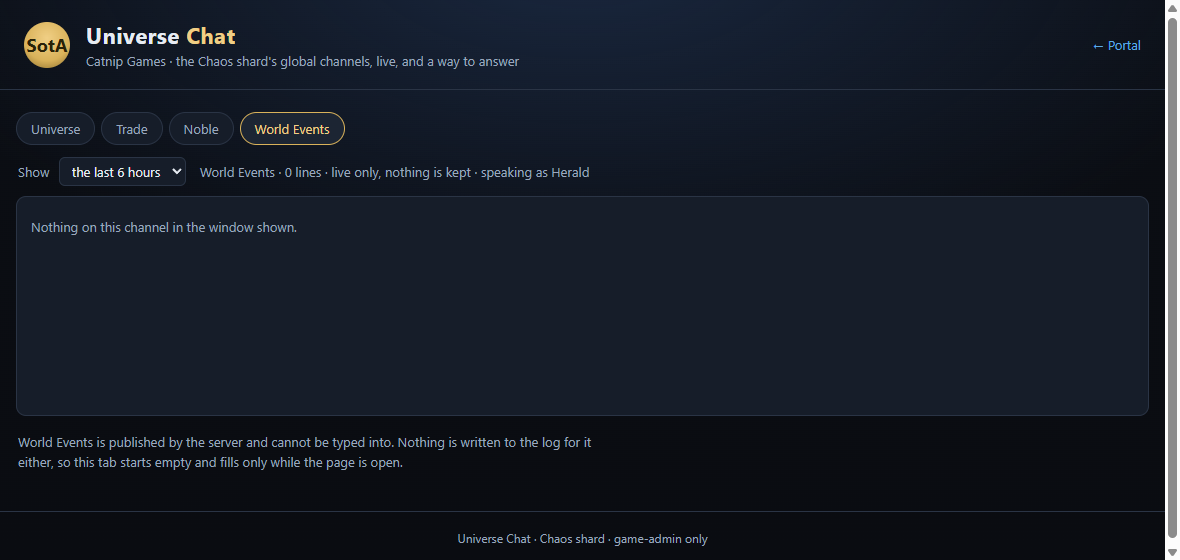
- The dev portal has a Universe Chat page. It shows the shard's four global channels — Universe, Trade, Noble and World Events — as a live transcript with searchable history, and it has a box for replying on the three that accept one. Before this the only ways to read global chat were the Mattermost mirror, which only goes one way, or being logged into the game.
- Replying rides a second chat relay that signs in as a dedicated account and speaks as its character, so a line from the page reads like any other line in chat. That meant no new server operation and no server change: the relay already spoke the ordinary client send, it just needed real credentials instead of a throwaway login.
- The send path got its own rate limit on the way in. The relay the guild site uses is rate-limited by the server; the ordinary send is not, because the game trusts its own client, so a stuck retry loop on a web page would have gone to every player online. Sends are capped per five seconds and per minute, and both the relay and the reply box ship switched off.
- Chat history for the page reads through a new log credential scoped to the three global channels and nothing else. The existing one belongs to the guild and town site and is restricted to guild chat; widening it would have handed every guild page the whole shard's global chat instead. The setup script proves the restriction before it finishes: whispers, guild chat and town chat must each come back empty.
- World Events reads but cannot be typed into, in both directions of the plumbing. The server publishes those lines past the code that writes the chat log, so there is no history to show, and it refuses player sends into that channel by name, so the page hides the box there rather than offering a button that would fail.
- The Universe Chat page is live on the dev portal and switched on. It reads the shard's global channels through a relay signed in as a dedicated account, and a line sent from the page arrives in chat under the character Herald. The first test line drew two replies from players in game within a couple of minutes, which is a faster round trip than the Mattermost mirror ever allowed.
- Switching it on for the first time found two things. A service account fresh from the accounts tool has no character at all, and nothing short of sitting in the game client could give it one, so the relay now creates its character once, by name, and only when the account has none. And a relay on a fixed account could not restart: the same account coming back inside the previous session's timeout is refused a new game assignment, which took two failed restarts before it was handled. A throwaway login never hits either, which is why the guild relay has run for days without meeting them.
- The repo now ignores the .work scratch directory that tools and sessions write intermediate files into. It had been showing up as untracked clutter where a careless commit could sweep it in.
- Added three more players to the chaos tester roster and refreshed the committed roster file, which had drifted since the 11th.
Client
- Offline single player is playable again. The Play Offline button on the main menu was disabled in every shipping build since August; it is live for everyone now.
- Starting offline play no longer asks for an account. It used to demand your account name and password or a Steam sign-in, then make two calls to the website before you could reach your characters, so offline play did not work without an internet connection. Those are gone: the menu goes straight to the agreements and then to your characters.
- Offline play now shows its own licence agreement and terms, which say Episode 1 in offline single player is free with nothing to buy and no account to register. The old text was the online agreement, which tied the licence to using the online service and to accepting the terms on the website.
- Fixed the offline load that stopped near the end of the bar and stayed there. A character whose combat decks would not read never finished loading, because the deck loader logged the failure and returned without telling the rest of the load it was done. Four other pieces of character data could do the same and now cannot.
- An offline save that failed one of its sixteen upgrade steps used to skip every step after it, for good. Each step now runs on its own and names itself in the log if it fails.
- Claim Rewards, the one part of offline play that still uses the internet, gives up after 45 seconds. The timeout had been written into the code for years and never applied, so a request to an unresponsive host waited forever.
- Sky no longer flashes bright streaks during the day. A second shooting-star emitter on the sky dome was firing without a time-of-day check, so its giant streak crossed a lit sky in a fraction of a second and read as a white flicker. It now waits with the other one for the sky to be dark.
- A Chaotic Clone summoned while wearing a size-changing artifact like the Faerie Belt now shrinks or grows with the avatar. The decoy used to keep its authored height while the caster changed size, which made it easy to spot side by side.
- Launcher self-update now shows a live progress line: "Checking launcher…" during the pointer fetch, "Downloading launcher update (N MB)…" counting up as the new build streams down, and "Updating launcher…" just before the relaunch. Before the fix the window sat silently on the first message for the whole download and looked frozen.
- A ghost is no longer slowed by the weight of its pack. The encumbrance movement penalty and Dexterity penalty were still applied after death, so a player who died over-encumbered walked to the ankh at the same reduced speed. Both now lift while dead and return on resurrection (#7705).
Images
- Offline single player:
- Oracle transcript, same answer, before and after the change.
Localization
- Spanish and Italian players had three lines that printed raw translation markup instead of the sentence: the player vendor count in a town's hover tooltip, and two lines at the top of the skills window. A masculine/feminine choice had been attached to a number, which the text formatter has no way to answer, so it gave up on the whole line. The three translations are corrected.
- The text formatter now falls back to the first wording when a translation asks it something it cannot answer, so the same mistake anywhere else costs a wrong article rather than an unreadable line. An audit of all eight translated languages found 118 numbered gender markers in use and three of them wrong; a test now checks the whole set against the English note for each string.
Client performance
- Zone loads on build 261 still froze the client for 10 to 62 seconds, after the change that removed the 10 to 22 second freeze the same load phase used to have. The old freeze reported which file it was stuck on, and that report went away with it, leaving six candidate steps and nothing to tell them apart. Each of those steps now names itself, so the next freeze says which one held the frame.
Server
- Worked out how player sign-in and store purchases will keep working when the test shard becomes the main server, and wrote the plan up: what stays where it is, what has to be proven before the switch, how the switch is sequenced, and how it is undone.
- That review also turned up a dozen wrong statements in our own documentation, from a payment job doing less than the docs claimed to a tax setting that would have expired player lot deeds far too early. All corrected in the same pass.
Audio
- Player vendors have a voice now. Opening a player vendor shop window plays a spoken greeting, and closing it plays a goodbye. They were completely silent before, standing next to town vendors and shopkeepers who have been voiced since June.
- The voice follows the vendor skin: the male models speak with a man's voice and the female models with a woman's. The Automaton vendor stays quiet, since a human voice out of a clockwork would read as a bug, and a vendor with nothing listed for a fortnight stays quiet too, matching the grey nameplate it already shows.
- The greetings reuse shopkeeper lines that were already generated and on the CDN, so this added no new audio files. All 35 vendor skins share those two voices for now; giving them their own is written up as a follow-up.
- Vendor greetings have their own switch under Options, Audio, called Player Vendor Voices. It is separate from NPC Spoken Dialog, so a player who wants quest dialogue but not a market row of greeting stalls can have both.
Combat
- Immolation now damages practice dummies. The rule that keeps a follow-you aura from starting fights with neutral bandits and farm animals was refusing every dummy too; dummies (and other inanimate targets) are back on the list of things Immolation burns.
- Summoned elementals no longer wear down the tamers collar, toy or accessory during combat. Tamed pets still consume that gear as before.
- Rainbow Blast's bloom lands centred on the caster now instead of about a metre off to the caster's right. The unicorn rainbow attacks still bloom from the horn.
Build and release
- The Mac client download had been twice its proper size since 15 September. Three builds shipped a second copy of the whole game beside the real one, 859 files and 12.5 GB of it, so the patcher asked Mac players for 24.9 GB where Windows and Linux asked for about 12.3 GB. The duplicate was a leftover clone of the app from the code signing work, left in the build output and picked up again by every build after it. It is gone, so the next Mac build drops back to about 12.5 GB and the launcher removes the extra folder from installs as part of that patch. Windows and Linux were never affected.
- Four checks now stand between a build and that kind of accident. Packaging clears its own scratch out of the build output and stops the build on anything else left there, the Mac signing step confirms its working copy is gone, the publish refuses a tree with scratch at its root, and a new size check fails a release when one platform is more than 1.25x another or a platform grows more than 10% over its own previous build. Run against the recorded sizes for build 255 the size check fails on both rules; against 254 it passes.
- Twenty-four build records that the patch host had written were sitting uncommitted and are now in the repo. Each one ties a build number to the exact code it was built from, which is what the patch notes page needs to work out what changed between two builds. Builds 190 through 196 had only recorded their Windows leg, so their Mac and Linux rows were missing, and builds 253 through 256 and 261 had no rows at all.
UI
- The Decks window no longer scrambles your arrangement when you delete a deck. If you had reordered the list with the up and down arrows or the swap field, deleting any deck kept the surviving decks in the positions you had set them in; before this fix the delete quietly reset the list to its underlying order.
- Saving a custom theme keeps the background image you had picked on the Options window. Creating a copy of a built-in theme with the Theme editor used to strip the custom image; the Theme editor's Backing pattern chip on Theme default now lets the Options window pick decide, and picking a catalog pattern like Parchment or Oak still overrides it.
- The ring right-click menu no longer draws a horizontal line under the three ring slot preference rows, so the ring menu now matches the necklace, boots, and other gear menus.
- The vendor My Listings tab now combines identical items when you drag one row of Your Goods onto another, matching how the backpack window has always behaved (#7752).
- The overworld hex over the Cabalist Stronghold reads "Cabalist Stronghold (Dormant)" for every client between cycles. The label was being hidden from dev/GM clients because it shared a check with the enter gate those clients bypass; the state label and the gate now sit on their own lines.
- Writing on a Blank Sheet of Paper honors the font you picked. Runic, Flowing Script and Illuminated now show through on the preview, the published paper and the inventory title; before, every paper published in the default font whatever the player chose.
- Save Settings to File now carries the themes you built in the Theme Editor, so loading the file on a new computer restores your custom UI colors, ornaments and fonts along with the rest of your options.
- The number fields beside the Range and Brightness sliders in the per-decoration Light Settings window now hold the digits you type until you press Enter, press Tab or click away. The old behaviour clamped as each digit landed, so a two-digit value whose leading digit sat outside the allowed band (typing 12 into a 5-15 field, or 84 into a 50-150 field) was never reachable. Values still snap into the allowed band on commit.
- A window a scene change hid mid-session and you never reopened stays closed on the next login. Before, the game remembered that you had once opened it and put it back up. Windows you actually leave open when you log out still come back.
- The titles list now has a search box, a category dropdown, and Founder and Active chips, in both the Titles window and the character sheet's Titles tab. A line above the list reads how many of your titles the filter is showing out of how many you own.
- Every title now carries a category, and the list gained a Category column you can sort by. There are fifteen categories: Pledge Rewards, Skill Mastery, Achievements, Quests, PvP, Subscription, Contests, Bug Brigade, Royal Court, Loyalty Rewards, Community, Developer, Purchases, Events and Base.
- No category was recorded anywhere in the game data, so the client works it out from the skill mastery tables, the achievement catalog and a table covering the remaining 150 titles. Building that turned up two titles that read as quest rewards and are actually granted by achievements.
- Both title lists stopped rescanning the whole title archetype catalog once per title per redraw. The character sheet redraws its Titles tab every two seconds, so that was several hundred lookups a second on a list nobody was touching. It builds one table now.
- The main Options row for Show Objects in Containers now updates an already-open backpack window live. Flipping it beside a pack that was already up used to need a close and reopen; the pack tracks the setting as you tick or untick it now, from either place. Reported on the tester verify for issue 4955.
- Party nameplate draw order is right the instant a party zones into a new scene together. A pooled plate could hold a stale "faded by distance" bit that the party path never cleared, which held that plate out of the nearest-first ranking pass and left teammates and creatures drawing over your name and health bar until the party was reformed in the same scene.
- Same-zone rows in the Vendor Listings in Zone window now show the vendor name a player has set, not the placeholder word Vendor. A same-zone row for a vendor nobody has ever renamed still reads Vendor.
- The dark border on the gathering mini-game ring is now wider, so the inner edge of the green and orange centre segments no longer washes out against the character while you gather.
- Added a "Close All Windows" keybind. It ships unbound; bind a key to it in Options and one press closes every open window at once. Pinned windows stay open, same rule as Escape.
- The Options window has a new first tab, All, carrying every setting from the other eight tabs in one scrolling list under a heading naming the tab each group came from. The window opens on it. The search box above the tabs already narrowed every tab at once; until now you could only see one tab's matches at a time and had to read a summary line to work out which other tab to click.
- Nothing on the All tab is a second copy. Each tab lends its rows to the page and takes them back, so there is one widget and one binding per setting: a slider moved on All reads the same on its own tab. The keybinding list travels as a unit with its own filter box and column captions.
- Fixed along the way: the check for a row its own tab is hiding used to walk up past the tab and into the window layer, which carries a hidden flag while another dialog sits over Options. With that dialog up, a search reported nothing matching anywhere in the window.
- Use Mouse To Move In Combat, the Controls-tab option added for weapon-drawn Auto-Attack-off players, now works on its own. It previously did nothing unless Use Mouse To Move was also on. Requested by Wishdragon, partial-verdict feedback from the testers.
- The quantity prompt arrow keys work on every opening, not only the first one in a session. The Left and Right nudge was registered when the prompt was first built, and the prompt rebuilds its contents each time it is closed and reopened, so from the second opening on the arrows went back to moving focus or the caret (#3694, build 261 verdict).
- A pinned pet sheet now survives Escape and zone changes, and repaints for the pet in the new scene, the same way the pinned character sheet has since build 148. The pet sheet is a separate window from the character sheet and had not received that wiring (#7667).
- Player vendors now have a Sales tab. It sits after My Orders on a vendor whose listings you manage and lists what of yours has been selling, one row per item with copies sold, gold received and the date of the last sale, sortable by any of those columns. The tally is read out of the vendor sale letters still in your mailbox, and the tab says so above and below the table, because letters expire after about two weeks. The same numbers were already available as /mysales; this puts them in the window.
Content
- The Simple Wooden Wine Crate no longer places as a bright purple box. Its prefab pointed at a material that had never been in the project, so Unity was drawing it with the pink fallback; it now uses an existing wooden crate material and shows up as wood.
- Scots pine trunks in Solace Bridge Outskirts no longer look blurry compared to the oaks and spruces beside them. Their bark textures were being imported at half the resolution of the neighbouring trees and are now on par.
- The town siege Cabalist walks to the shrine and paces around it while raids watch the town from the road, without anyone having to come close first (#7092).
- Blue Spruce bark on the bare and needled trees in Solace Bridge Outskirts (and every other scene that uses them) now stays at its authored resolution up close instead of loading a blurry lower mip. Fixes issue 6541.
- The magic mirror on the Isle of Storms now takes a click anywhere on it. Its clickable area was a sphere sitting about 1.2 metres above the mirror, so the bottom third of a three-metre mirror answered nothing; it is now a capsule that covers the whole face and the small drift the mirror has as it floats.
Vendors
- Vendor sale letters now add up. A new tally folds every sale letter still in your mailbox into one row per item, showing copies sold, gold received and the date of the most recent sale, so you can see what has been moving instead of counting letters by hand. Requested by belladonnarose. Rows group on the book rather than the cover, so printed copies of one title count together and two different player-written books stay apart. Run it with /mysales, or /mysales books for just the books.
- The tally counts only the letters still in your mailbox, and says so in its first line. Sale letters expire about two weeks after they arrive, and they go immediately if you discard on Take All, so the header names that limit rather than leaving a merchant to restock off a number with invisible gaps in it.
- Buy orders on a player vendor can now be filled a few at a time. A poster placing an order for a stack leaves Accept partial fills ticked and types the price of one; sellers then hand over any number up to what the order still wants, and the rest of the order stays on the vendor. An order for 1,000 mandrake used to need one seller with all 1,000 in a single transaction, so anyone holding 3 could not touch it and anyone holding 1,003 had to split the stack by hand first.
- A seller is paid the price of one for every unit they sell into an order, whatever number they sell at a time, and the commission the poster paid up front is charged a share at a time as the order fills. The tests assert the deposit is conserved to the coin across any sequence of sales, since the gold travels the opposite way here: on a listing the commission comes out of the seller's proceeds, on an order it is money the poster already put down.
- A seller who hands over fewer units than they asked to sell is now told they do not have enough. That case used to answer with the damaged-goods message, so players were told to repair items that were never damaged.
Options
- The settings file you save from Options is now plain JSON. It was a flat list of four-part rows, and the parts holding your key bindings and chat tabs were squeezed into one line of escaped text, so the file could not be read or edited by hand. It is now grouped by section with each setting under its own name, and the key bindings and chat tabs sit in it as ordinary nested entries. A full capture is 229 settings in about 10 KB. Settings files saved by older builds still load, and saving one again writes it in the new shape. Requested by Gravidy.
Tools
- Addons can now ask the game for a skill icon by name. A new Lua function
ShroudGetSkillIconhands back the same texture id the buff bar uses, whether or not the skill is on the player, so a pack like Buff Monitor can show art for any skill without shipping its own copy of the picture. The addon feature flag moves to version 7 for packages that want to gate on the new call.
Chat
- Chat lines from a game master now draw in purple across the player channels, including the Herald account that posts into Universe chat. The colour covers the whole line, sender name and message text; before this a Herald announcement rendered in the same grey as ordinary Universe chatter.
Client UI
- The question mark in the top-right icon row now opens the Oracle window in game instead of a guide page in the browser. Offline, or on a shard with the Oracle switched off, it still opens the old guide page, so the button is never dead.
- The Oracle window has a Clear button in its title bar. It empties the transcript and drops the conversation, so the Oracle starts fresh. Before this a conversation lasted until you quit the game: closing the window, changing scenes and logging out to the character screen all kept the old transcript and the Oracle's memory of it. A reply still on its way when you clear is discarded rather than landing in the new transcript.
Oracle
- Oracle answers now open at their first line. The transcript used to snap to the bottom of every reply, so an answer taller than the window left you looking at its last paragraph and you had to scroll back up to start reading it.
- The source links and the tracker outcome line that arrive a moment after an answer no longer move the view. They used to re-snap the window to the bottom one line at a time, which pulled the page away from anyone reading or scrolling. A knowledge base page opened from a source link starts at its own first line too.
- Ask the Oracle where to buy something and she now names the shops and the towns. She had no record of what any shopkeeper stocks, so the best she could do was suggest trying another town. The new record covers 360 NPC merchants across 64 towns and 16,457 shop entries, and answers three ways: by item, by town, or by shopkeeper.
- Checked whether shop contents are actually stable before letting her state them as fact. They are: across every loot bundle a merchant can reach, nothing has a drop chance below 1, a weighted alternative, or a seasonal filter. Only the number on the shelf moves. So a shopkeeper who does not have what you want today will not have it tomorrow either, and the guides now say that instead of telling you to come back later.
- The stock data is a lookup tool rather than more pages in her knowledge base. Written out as text it would have been about 240 near-identical shop lists competing with everything else for the six slots a search returns, which would have made unrelated answers worse. As a tool it costs nothing until she calls it.
- Asking for an item that does not exist used to be a trap. "Where do I buy dragon steak" matched Tuna Steak on the word steak, and she was under instructions to answer from what the lookup returned. A result that leaves one of your words unaccounted for is now reported as a near miss, so she says nothing is listed under that name.
Perforce migration
- Brought the last of the Perforce content across to git: 156 changelists from 21 July to 1 September, landing 96 commits. 347 files added, 258 merged, 235 applied unchanged, 83 deleted. Store items, recipes, deco, icons and the machine blacklist all moved; the scene edits could not, and are listed as owed.
- A Perforce rename of a file git had already fixed turned out to silently undo the fix: the rename lands the old Perforce copy at the new name while the fixed copy is stranded at the old one with no metadata. It backed the layer-20 change out of four player-dungeon hall pieces, which would have turned 22 decorating surfaces back into invisible walls. Caught and reverted, and written up so the next import looks for it.
Items
- Rebaked the item and store catalogs over the import. Small Bag is now Small Leather Bag with a dyeable canvas version beside it, the toy rowboat replaces the old Row Boat entry, the Bug Brigade glue trap is retired, and the dyeable straw fan, four stackable buckets, Baroque mirror and rug, wine presses and crate, and the fan emote bundles all have catalog rows for the first time.
2026-09-16 · 48 items
The New Britannia Herald
Companions answer the call and the Hidden Vale finds its voice
Headlines
- The Hidden Vale world map went from no ambient sound at all to 24 sources of it, changing between day, dusk, night and dawn, and the Ambient volume slider finally has something to move.
- Offline companions can be called at last: a new /companions command summons, swaps and dismisses Fiona, Conrad and Ariel, and the console path that printed success while doing nothing is fixed.
- Companion AI pass: a companion's level stops at yours, each of the three has an authored personality and abilities that fire when hurt, a badly hurt companion falls back to your side until it recovers, and a companion joins whatever you are fighting without an order.
- Four more companions planned for Q4 2026: Edvard the Wanderer, Captain Bearfield, Marcus the Vigilante and Captain Kinsey, with the per-companion recipe written up.
- Chaos log cleanup: the two loudest client warnings, the crosshair line on every zone load and the hidden pointer after a camera turn into a zone exit, are fixed at the cause. Blank sheet music, the guide wisp and the lot list also stopped throwing errors or refusing without a word.
- Loading into the world stopped waiting on the bank item list (up to 53 seconds in the logs) and stopped freezing at the start of zone loads.
- The Clink's prison riot opens the cells again, and the cell doors stay in step between players; a Cabalist's body now stays lootable after a town siege ends instead of vanishing on the spot.
- Tracker pass. Closed 1 item from the tracker.
- Seven player-run towns stopped dropping arrivals into the water. Forewind and its six sister towns share one template whose arrival point sat a hundredth of a metre above the ground, and about half of all arrivals fell through to the water bed under the town.
- Planter growth rates are now bounded by the server. A rate from outside the range the game authors can no longer ride a planter through a bank and back onto a plot.
- Use this container for crafting stays set. Closing a chest was putting its old setting back, which is why the tick only held after picking the chest up and placing it again. Use lot storage also works in dungeon Adventure Mode now.
Build pipeline
- The overnight chaos release failed on the Windows client after a clean build: the shader health check could not open the build log while a leftover Unity process still had it open, and reported that as a shader compiler failure. Both log readers now share the file and retry, and an unreadable log is reported as unreadable.
- The morning chaos release failed seconds into the Windows client build: an overnight test run left Unity open on the build project after the Windows agent lost its connection, and the build launched before the killed editor let go of the project lock. The build now waits for the old process to exit and the lock to clear, and names what still holds it if it never does.
- Three chaos releases this week failed seconds into a client build because a job aborted to make room for the release left Unity running on the build project. Every Unity job on the build machines now goes through one guard: it kills anything left on the project, waits until it has actually exited and the lock is free, and runs Unity so that aborting the job takes Unity down with it. A release preflight check fails if any Unity step skips the guard.
- Found why the next release also failed: the aborted test run's Unity was killed but never finished exiting, and kept the project locked. The build guard now recognizes that state within 30 seconds and says the build machine needs a graphics driver reset or a reboot.
- The build guard now reports a stuck Unity process correctly on the Windows build agent. Before, the error from the failed kill stopped the guard before it could say the machine needed attention.
Audio
- The Hidden Vale world map had no ambient sound at all, so travelling it was silent apart from your own footsteps. It now carries 24 sound sources: surf and gulls around the coast, town murmur at Kingsport, Braemar and Owl's Head, forest beds through Ravenswood, Kingswood and Greymark, marsh on the three swamps, the river north of the vale, and wind over the Wyrmsands, Wynton's Folly and the Moors of Northshore. Novia carries 35 of these and the Mistrendur continent 31.
- The forest beds follow the clock: birds by day, an owl at night, a dawn chorus in the morning and crickets at dusk. That answers the second half of the same report, that the Ambient volume slider did nothing on the world map. The slider was working; the map had no ambient sound for it to adjust.
Companions
- Offline companions can be called now. A new chat command, /companions (list, summon, swap, dismiss), calls Fiona FitzOwen, Conrad Dupre or Ariel Rosehaven to your side by first name, swaps one in when all three slots are taken, and sends one away. The only path that existed before, the summoncompanion console command, handed the summon no item and printed success without doing anything.
- The typed pet commands (/pet stay, follow, attack, stop, teleport and /petstate) now reach every pet and companion you have out. Before, they only reached the tamed-pet slot, so a companion took orders from its right-click menu alone.
- A conversation line that dismissed a companion turned that companion hostile instead of sending it away. It dismisses now.
- Nine tester dials under pets.companion.* (level share and cap, personality weights, retreat, assist) went in ahead of the companion AI work that reads them, so each step of it can be walked back with one number.
- An offline companion's level now follows yours and stops at it. Before, a companion added nine tenths of your level to its own starting level with no cap, so a level 5 character had a level 9 companion at its side and a level 20 character a level 23 one. Above level 50 nothing changes.
- Fiona FitzOwen, Conrad Dupre and Ariel Rosehaven now fight by who they are. Each companion carries an authored personality (Fiona and Ariel lean towards healing and support, Conrad towards fighting and coming to your aid), abilities that fire only when hurt (Conrad goes berserk at half health and unleashes Whirling Blades when enraged, Ariel throws a Ring of Fire at half health and blinks away when nearly dead, Fiona blinks away too), and a fuller kit: Conrad buffs your damage resistance, Ariel roots enemies and hastes you. Ariel's spells also gained the Fire and Air attunement every NPC caster of her level already had. Before this pass none of the three had a personality, a hurt-ability or an attunement authored at all.
- A badly hurt offline companion now falls back to your side and holds there until it has recovered some health, then rejoins the fight. Ariel Rosehaven breaks off at 35% health, Fiona FitzOwen at 30% and Conrad Dupre at 25%, each returning 15 points above that mark; a companion told to stay holds its ground regardless. This is a short step out of melee inside the fight logic rather than the creature rout, so the companion never runs off across the map and a healer still heals while falling back. Before this, every companion stood and swung to its last point of health.
- An offline companion in its normal stance now joins whatever you are fighting without an attack order. It attacks the enemy you have selected as soon as you are in combat with it, follows you to a new target after about four seconds on the old one, and still holds back when set to passive or told to stop. Before, a companion only ever fought on an explicit order or for three seconds after something hit you, so it stood and watched you fight.
- Planned for Q4 2026: four more companions promoted from story characters, each swappable through the same command. Edvard the Wanderer as a healer, Captain Bearfield as an archer, Marcus the Vigilante as a rogue and Captain Kinsey as a tank who taunts. The recipe for each (prefab pair, matrix row, summon rune and call item, skill id, kit and personality, voice) is written up so the additions are one commit apiece when that work starts.
Server
- The master server now keeps a connected login's record alive while that login holds a game assignment it has not used yet, and clears the assignment once it goes stale. The web chat bridge holds one on purpose, so its login record used to expire about five minutes after every bridge restart and the server logged a warning each time.
- A player whose character was in the world when the server restarted could wait up to four minutes on "Waiting for your character to leave the previous scene" after logging back in. A restarted game server now clears the zone assignments its previous run left behind, so players reconnecting after a restart load straight in.
- The login and connection guide now explains when the game makes a player wait for their character to leave the previous scene, which server moves that state on, and the four ways a stuck wait is released.
World
- Wrote up the 39 NPC towns in the game as a single reference: how the scene registry separates a developer-authored town from the player-owned and player-run ones, plus a table of every town with its quest, quest-giver, NPC and housing-lot counts.
- Ranked those towns by the quest content each one authors itself rather than inherits from shared town-crier dialogue. Central Brittany reads as 24 quest chains but 9 are its own, and Kingsport 16 against 6.
- Seven settlements are registered as adventure scenes rather than towns, so they sit outside every town list we keep and miss the town rules: no busking, no exemption from the idle kick, and skill decay in five of the seven. Port Harmony is one, with more quest content than every town on the list except Ardoris, Resolute and Aerie.
- Arriving at Forewind, Aldwater, Endurance, Port Titan, Coral Cove, Brekken Bay and Taenby Landing no longer drops you into the water under the town. The seven share one template, whose arrival point sat a hundredth of a metre above the ground; the one metre of random spread applied to every arrival landed on higher ground about half the time, and the spawn then took the water bed below instead. The arrival point moved up by just over a metre. (#7719)
Guilds & Towns
- A player banned from a player-owned town who tried to enter it while other players were inside got the ban message, was sent back, and then sat on the loading screen for up to four minutes on every zone change. The refused entry now clears the pending trip, and the server checks the current login record before holding anyone, so the trip back loads normally.
UI
- Town hover panels now name their visit status in plain words: Discovered in green or Undiscovered in gray, on the overworld map and on the destination lists opened by wagons and balloons. The visual panel used to lean on a small checkmark and the wagon or balloon list showed nothing at all.
- Double-clicking a recipe at a crafting station no longer briefly flashes "No Recipe Found" between the click and the recipe details appearing.
- Loading a settings file with Window Layout ticked now moves the windows that are already open. Before this the layout only appeared the next time you started the game, and closing one of those windows in the meantime saved its old position back over the value just loaded. (#7746)
Client
- When a character's reserved effect slots turn away an enemy effect deep in a fight, the client now writes one warning and then a per-minute count by effect, instead of an error for every refusal. One siege session on chaos had logged 454 of those errors, which used up the log upload budget and lost the rest of that session's diagnostics.
- A hotbar slot holding a retired skill such as Frenzy, or an old Poison Weapon glyph from before that skill became passive, is now cleared from the saved bar the first time it is found at login. Before, the slot was only emptied for that session, so the same cleanup and log line repeated on every login.
- Rooted plant creatures no longer log a movement speed warning when they turn to face a target, and a pet whose AI is still loading during a zone change no longer logs an error.
- The crosshair load warning stopped firing on every zone load. The check that hides the crosshair when a load starts was also logging that first frame as a leak, about 700 lines over two days of chaos builds 253 to 255; it now logs only if something puts the crosshair back after it was hidden.
- A right-drag camera turn that ends during a zone load now gives the mouse pointer back the moment the button comes up. The drags release lives with the camera, which stops running once a load starts, so a player who steered into a zone exit and let go on the loading screen kept a hidden pointer until a safety check restored it half a second later, with a warning in the log (about 60 on chaos builds 253 to 255, every one within seconds of a load).
- Loading into the world no longer waits for the bank item list. Over 48 hours of chaos logs that list took 10 seconds to load at the median and up to 53 seconds, all of it inside Equipping Avatars, with the HUD waiting behind it for up to 27 seconds. It now loads in the background after you arrive.
- Zone loads now mount the shared map files in the background before the scene loads. In ten days of chaos logs, 25 sessions had the loading screen freeze for 10 to 22 seconds at that step. The slow-load warning also names assets that are looked up by id, which used to print as an empty path.
- The "Probable hitching caused by Deco" warning now reports how the time split between creating the object, scanning it, wiring its interactions, its visuals and its network setup. Commission-Free Vendor and Tomb Dungeon Entrance logged it about 700 times in ten days at 70 to 100 ms each, while copying either model takes under 1.5 ms, so the next logs can show which step is slow.
- Cows, dogs, cats and bears stopped answering a question about the time in plain English. Only speaking races (humans, elves, kobolds, satyrs and fauns) recite the hour from the game clock now; every other creature falls back to the noise or line its own conversation file gives it, and an NPC with its own "time" answer keeps that answer (#7750).
Books
- Blank Sheet Music no longer offers "Write It Myself", which it never supported and which left the window stuck on the choice screen. The edit choice now refuses any option a writable item cannot serve instead of throwing, and a failed publish from the import screen falls back to the choice screen on items that have no import. (#7730)
Housing
- The lot list now says why it will not open outside a town: a chat line reads "That window is only available in a town." It used to do nothing at all, and the client logged the refusal as a window that failed to load.
- Decorations whose base is gone from the lot, for example items left on a table that was picked up years ago, no longer vanish silently on every visit. When the owner or someone allowed to move them next loads the lot, they are moved into the decoration list, where they can be placed again. If the base turns out to have only arrived late, the items are put back on it instead. Items resting on a base that is stowed stay hidden and come back when the base is placed again.
- Planter growth rates are now held to the range the game actually authors, from a tenth of normal speed indoors up to double under a greenhouse roof. A rate outside that range could ride along on a planter through a bank and back onto a plot; it is now corrected wherever the rate is read, stored or moved between containers. Planters that never had a rate recorded still grow at normal speed. (#7249)
Guide
- The guide wisp puts itself away cleanly when the vendor it is leading you to stops being a destination (you arrive, pick another vendor, or leave the zone). It used to read the removed destination for a few frames and log an error. Hovering a compass or map marker as it disappears no longer logs one either. (#7731)
Interactives
- The cell doors in The Clink during the prison riot now stay in step between players, and the riot opens the cells again. A switch that only exists in the riot version of the prison names all twelve doors, and it switched on a moment after the doors had already been set up on their own, so every door lost its shared state and the switch shut itself off. Shared doors, levers and switches now wait until a scene's variant has been switched on before they pair up. (#7729)
Sieges
- The Cabalist's body no longer disappears the moment a town siege ends. Clearing his post marked everything on it to leave at once, his corpse included, before the body was handed back to the town, so nobody could loot him. His body now keeps the normal corpse time like any other creature, and every player in the town hands the fallen army back the same way when the siege ends. (#7378)
Items
- Gear you take off or put on in the last second before a zone change or a trip back to the character list now stays that way. The change could wait out the scene change and then be dropped, so a helmet taken off at the gate could be back on when you arrived, or be recorded against the next character you logged in. A character whose record still named an item it no longer owns now has that slot cleared once, after the game has confirmed the backpack finished loading, instead of reporting the same empty slot on every load.
Launcher
- The launcher on macOS now names its menu bar Chaos Shard. It read Avalonia Application, after the toolkit the launcher is built with, and carried an About Avalonia entry alongside it. Windows and Linux do not use that menu and are unchanged.
Crafting
- A change to Use this container for crafting made while a chest's window is open now stays when the window closes. Closing the chest used to put its earlier setting back, so crafting stations kept counting the old setting, a logout showed it again, and picking the chest up and placing it again was the only way to make a change stay. Locking or unlocking a chest with its window open was undone the same way and now stays too. Reported by gravidy. Chests that lost a setting need ticking once more.
- Ticking and unticking Use this container for crafting quickly while a crafting station was open could leave the station counting the earlier setting until the station was closed. The station now catches up within a few seconds.
- Use lot storage now works at crafting stations in a player dungeon in Adventure Mode. It had only worked in Decoration Mode, because the station was checking whether you could place decorations there. Reported by inuphet.
2026-09-15 · 104 items
Headlines
- Linux players in full screen can click the whole of a button again: the game had been reusing a shorter window size, which put every click 29 pixels below the pointer.
- A connection drop at a crafting station left your character hanging in the air with no way down. Crafting now releases you on every exit path.
- Paying a Mage of Mystery for the north entrance of a control point now gets you the north entrance. Five of the six passes handed out the opposite end, and Eastreach Gap could not sell its south entrance at all.
- Combat decks no longer take off gear they cannot find. A deck that remembered a piece missing from your pack emptied that slot and saved the change, so the gear was still off after a relog. The slot is now left alone.
- Player dungeons: logging in inside your dungeon no longer breaks spell targeting, pets and monster pathing until you leave and come back.
- Gathering pass limits now follow Meticulous Collection: 2 passes a node with none of it, up to 12 at 75 percent, so landing every swing no longer pays everyone the same.
- Guild and town prestige ladders: every guild and player-owned town now earns a monthly rank from kills, crafting, gathering, vendor trade, decorating and time spent, with lifetime Renown tiers on top.
- Eleven artifacts stopped lying: the Glancing Blow Chance affix on the Gambler rings and the Cabalist Nefario Hood was printed on every tooltip and read by nothing. It works now.
- Japanese typed into chat keeps its characters in order. Confirming a word had been scrambling it, so てすと went out as てとす.
- The Songs of the Sundered Blade book now says where each of the 30 wax cylinders is and what holds it, cylinders drop at 30%, and every song can now be reached by veteran characters.
- Judgment no longer leaves you stuck. Cast with no enemy nearby, it committed you to a beam that never released, and the movement block survived dying, recasting and the rest of the play session.
- Offline merchants sell raw materials. Ore, wood, cotton, leather, bark and animal parts at the trade shops in single-player only; online stock unchanged. Idea from the_catdude, give him a follow.
The Herald
- The New Britannia Herald for 2026-09-14 is up: Monday was the end of a long-running bug that removed gear you were wearing, a deliberately failed release that proved our rollback had never worked, and a large pile of music leaving the game download. New character names now get checked before they are allowed, the guild website learned to talk back to the game, and ninety-seven tracker items closed. Listen or read the transcript (16 min). Subscribe in any podcast app: /blog/podcast.xml
Community
- Filed two player suggestions from the forum: an agriculture depth pass (seed economy, crop rotation, grow lights, automated beds) and a POT/PRT/NPC-town ownership pass (governor tools, town ratings, deed consolidation), both from Ceal Astra.
- Guild and town prestige ladders: every guild and player-owned town is now ranked each month on what its people do. That covers creature and boss kills, crafting, gathering, fishing and taming, trade at player vendors and NPC merchants, decorations placed, and time spent. Time visitors spend in a town counts double. Not on chaos yet.
- Each member's contribution is soft-capped for the month, so ten regular players outscore one player doing ten times the work. Guilds are ranked against guilds of their own size (under 10, 10 to 29, or 30 or more active members), and towns against towns of the same size tier.
- Trading gold between two members of the same guild earns that guild nothing, standing idle adds nothing, and a decoration picked up and put down again only counts once.
- A finished month adds to a lifetime Renown total that never resets. Renown gives a guild a tier from Unknown to Legendary and a town a tier from Waypoint to Legendary. Rewards are cosmetic only.
- Standings show on two new Leaderboards boards (Guild Prestige and Town Prestige), on a Standings tab for every guild and town on the community portal with a Standings page for both ladders, and as two lines in the Social window's Guild tab and the Town Console.
- Discord Oracle bot built: players can @mention it or use /ask in the community Discord's #general and get an answer from the same guides the in-game Oracle uses, posted in a thread. It answers questions only; bug reports are pointed at the in-game Oracle. Not live yet, waiting on the Discord invite.
Combat
- Fixed bleed attacks on clockworks and slimes in a group: for every player but one, Rend and similar attacks lost their weapon on-hit effects on those creatures. The oil and acid spray still answers whoever made the creature bleed.
- Cone of Cold now puts its chill on the targets it hits. A blank line in the spell's data file made the game stop reading its effect list early, so the chill that makes targets take extra melee damage from a Water specialist never landed from Cone of Cold on any build. Ice Arrow, Ice Fist and Ice Field were unaffected. (#6776)
- The Water chill's extra melee damage now also applies to the Ice Fist, Stone Fist and Flame Fist punches and to the summoned Earth and Ice Elementals, which fight up close but carry wand-type weapons the ranged exclusion was dropping. Flame Fist's burn, ranged summons and player wands still get nothing, and the 15% cap is unchanged. (#6788)
- The Glancing Blow Chance affix on the Ring of the Gambler and the Cabalist Nefario Hood now does something. All eleven of those items listed the stat on their tooltips, but combat never read it, so the rings gave no extra protection and the hood cost nothing. It now raises and lowers your chance of taking a glancing blow, by about half a percentage point for a ring.
- The Acrobatics skill listed an innate reward called "Armor Movement Effects". No armour in the game carries a movement penalty, and what the reward actually does is make Sprint stronger, so it now reads "Sprint Effectiveness". The reward itself is unchanged.
- Went through a list of six supposedly dead identifiers in the armour and avoidance code. Three no longer held: one had already been fixed, the Universal armour category turned out to be live and carrying the Bonesteel Crown, and the glancing-blow stat was authored on eleven items rather than none. The rest are now documented in place instead of deleted, since the stat ordinals are baked into authored items and rune formulas.
- Fixed Judgment leaving you unable to move when you cast it with no enemy nearby. The spell commits you to its beam as the cast lands, and the release was tied to the beam finding something to burn, so a cast into empty air committed you and nothing ever let go. It lasted the rest of the play session: dying did not clear it and casting Judgment again did not either. The same lock could catch you with an enemy in front of you, if it moved out of range while the spell was going off. The commitment now waits until the beam has attached to a target, so a cast that lands on nothing releases you straight away.
- Judgment cast into empty air now plays a fizzle. It is a magic spell, so the miss sound that covers weapon skills never applied to it, and the cast went by with no sound and no visual while still spending focus and starting its 30 second cooldown.
Decorations
- Chased down a report that heraldry never showed on a Heraldry Throne. The throne was arriving without the parts that drive it, so it painted no crest and could not be sat in, and nothing in the game said so. The packing fix for that shipped in build 196 on September 12; the report came from 195, the last build without it.
Build
- Added a test that walks every decoration and equipment archetype, resolves the prefab each one points at, and fails if a prefab carrying scripts could be packed away from the thing that references it. That is the fault behind both the throne and the tabard crash. It checks 19,922 references across 40,032 archetype files in about five seconds and needs no build to run.
- Code signing: the Windows signing path was probed end to end ahead of the certificate purchase and fixed in four places where a failed signing would have looked like a success. The deploy-time signature check now verifies the signer and certificate chain instead of only checking that a signature exists, so a self-signed client can no longer pass it. The signing tool is installed on the Windows build agent, and a single script repoints all six installer projects at the new certificate once it is issued.
- Mac code signing: the launcher release script can now notarize and staple both Mac launcher apps with Apple, and Mac client builds re-sign the game after its data is copied in. Until the Apple developer account exists, every Mac build checks on a throwaway copy that it would sign cleanly. A test on the current Mac build also showed its folder layout needs no change for notarization, which corrected an earlier note that said it did.
- Mac code signing: the Apple Developer ID certificate is installed on the Mac build agent, and a copy of the current Mac client was signed with it for the first time. The signature verifies and macOS recognizes the developer. Signing from the build agent failed at first because of how macOS locks keychains in remote sessions; the signing scripts now work around it. Notarization is next.
UI
- A new Lock Hotbar Position tick in Options -> Interface -> Hotbar. When on, the bar cannot be dragged from its grip or a row surface, so a stray press stops parking it somewhere new. Off by default. Requested by paul2726 in Redmine #7592.
- Gave the crafting-station recipes list a little more breathing space: the level requirement no longer presses against the first ingredient, and each recipes last ingredient no longer presses against the next recipe below it. Reported by Astirian.
- Merchant, vendor and trade windows sign your name in the old cursive handwriting again after a purchase, the way they used to before the recent UI conversion.
- Theme Editor: the editor now applies the theme it opens with straight away. It used to wait for your first edit, so that one edit put the whole theme on screen at once, and unsaved work left over from an earlier session came with it. Changing a single colour read as every open window resetting to default.
- Two fixes alongside it. Unsaved theme work is only restored while you are still on the theme it was left against, so an abandoned draft cannot arrive over a theme you picked afterwards. And a colour change made in the last fraction of a second before you press Save no longer undoes the save, which used to flip the status from Saved back to Unsaved changes.
- Mount icon on the HUD now dismounts on right-click as well as left-click, giving a quick dismount option that leaves the hotbar layout alone.
- The top-left title, character name and guild name now carry a darker halo behind the text, matching the weight the overhead nameplates already had, so they hold up against a bright sky (#6428).
- The key you have bound to Interact now also lands the harvest swing meter, so one bound key can start a harvest and time the swing. The dedicated Harvest Swing key, Jump and left-click still work exactly as before.
- The Vigor bar hover and the character sheet described the same bonus against different baselines, so at a full bar one read 100% and the other showed half a row. The hover measures what Vigor adds on top of the rate an empty bar leaves you; the sheet printed the amount paid, which on a doubled row is half the total. The hover now names its baseline, and the four affected rows print that same percentage beside the amount, so Health Regen reads 7.6 with +3.8 Vigor (+100%) next to it.
- The two critical chance rows carried their Vigor figure beside the wrong number. It is measured in critical rating, the value in brackets, while the row leads with the chance that rating converts to, so at 12.5 rating a +6.3 sat next to an 11.1 it had nothing to do with. It now sits inside the brackets. A character with a health or focus drain was also shown a Vigor bonus on that row that Vigor never paid.
- The Vigor bar hover on the player status frame now reads correctly in German, Spanish, French, Italian, Japanese, Portuguese, Russian and Simplified Chinese. Non-English players were being told at a full bar that their health regeneration, focus regeneration and critical hit chance were being slowed by 100 percent, which is the opposite of what the bar is doing. The translated tooltip now matches the English wording that Vigor is adding that bonus on top of what an empty bar leaves, and the character sheet Vigor segments carry the same figure in every language.
- Settings, Interface, Reset Positions put the on-screen quest tracker back on top of the player's own status frames, running the tracked task lines through their own buff and effect icons. The tracker's home spot was set by eye during the UI Toolkit conversion, at 200 pixels down; the converted status frame reaches 220.3 pixels down at its tallest, with a title, a guild line, the Vigor bar and two rows of buff icons. The home spot is now worked out from that frame's own height, the way the pet frame's spot already was, and lands at 246 pixels.
- A quest tracker nobody has dragged now follows that spot on its own. It steps aside when a pet, a companion or a party frame appears beside it, and comes back when they go, with no trip to Reset Positions. A tracker you have dragged somewhere stays where you put it, then and afterwards. The corrected spot also reaches characters who never pressed the button, which is most of them: the tracker saves where it sits every time you change zone, so having a stored position never meant the player had chosen one.
- Party frames stopped drawing across your own status frame at their default spot. The party column home slot is now worked out from the player frame full height instead of a fixed number that fell behind it, so on a character who has never moved either frame the party rows sit clearly below your own bars. A party column you have moved yourself is untouched.
- The Blank Sheet of Paper no longer offers a Load From A File button that did nothing when clicked. The same trim applies to parchment scrolls, flyers, and the seasonal cards, none of which have ever supported loading text from disk. Blank books still offer the button and it still works. Fixes #7653.
- The Lot Deeds window now has a Tax Status column, reading Taxed or Tax-Free for each deed. It sits after Days Remain, so the existing columns are unchanged, and it reads correctly for a deed still in your inventory as well as one placed on a lot.
- Deleting a combat deck now asks for confirmation first, naming the deck. Cancelling leaves the deck exactly as it was, and deleting one that is equipped or set as the alternate still takes it off properly before removing it.
- The Teleport to Zone list has two new toggles, POTs and Adventuring, so a long list can be narrowed to one kind of destination. Both start on, so the list looks the same until you turn one off, and each character remembers its own setting.
- The Crown Shop category list now opens wide enough to read names like "Furniture: Seating & Beds", and the divider beside it widens the list a long way. The earlier fix kept every column of items on the shelf, which at most window sizes left the list only a few pixels of room; the shelf now gives up columns to the list and always keeps at least one (#5179, #5010).
- Fixed the text under the compass drawing flat. The date and weather line, the scene name and the scene type line have their thin black outline and top-to-bottom shading back, so they read over a bright sky again (#7690).
- Added Gathering Meter Contrast to Options, Interface tab. Default keeps the colours the harvest swing meter has today; High Contrast draws the target zone in cyan and the sweeping marker in magenta, and makes the see-through grey track solid black so terrain stops showing through it. Requested by Chadwyck, who could not follow the ring as the target area shrank.
- A perfect hit on the gathering meter was drawn in the same gold as the band it lands on, so once a node had paid out its bonuses there was nothing to see. Both wedges now darken for a moment when you land one, leaving the gold marker as the only lit thing on the ring.
- The gathering meter played two pitches of the same click for a perfect hit and an ordinary hit, which is why they sounded identical. A perfect hit now has a sound of its own, and a miss has one instead of playing nothing.
- The Filter box in the teleport scroll's Select Destination window keeps a readable width now. It had been squeezed to a checkbox-sized square beside the POTs toggle, and the tournament sort option ran off the window edge. The toggles now sit next to their labels and wrap to a second line when the window is narrow (#7689).
- Japanese typed with an IME came out in the wrong order once a word was confirmed: てすと typed into chat was sent as てとす. Unity's text engine put every character after the first one place early when the confirmed word reached the text box before the IME finished composing. The game now closes the composition first, in chat and in every other text box (#7692).
Combat
- Judgment now ends cleanly when the target dies mid-channel: the burst detonates on the corpse and the caster is free to move immediately, even with "Prevent Movement While Casting" on. Previously a killing blow from a pet or partymate could leave the beam holding the caster in place until they recast Judgment or left the scene.
- Switching a combat deck could take gear off a slot and put nothing back, and because the change was saved to the server the slot was still empty after a relog. A deck remembers what you were wearing when you saved it, and if one of those pieces was not in your pack at the time, the swap emptied the slot rather than leaving it alone. A slot whose remembered piece cannot be found is now left as it is, and the rest of the deck gear still goes on. Decks saved with a slot empty still clear that slot.
- Three more control points now field the named enemy on their final wave every run: Eastreach Gap for the level 140 lich caster, Vertas Pass for the red spider, and Vauban Pass for the Ebon Dawn ranged miniboss. Each final wave used to cap its population at ten of eleven authored seats and pick which one to drop at random, so about one run in eleven finished without the named enemy showing up at all.
- A starting character deck recorded its linked gear by position in a hand-written list of twelve slots, while the code that reads it back treats the position as the slot number. Eleven of the twelve lined up. The twelfth was the right ring, which is slot 29, so it would have come back as a necklace, and the necklace and belt slots could not be recorded at all. The list is gone and the gear is now stored against the slot it belongs to. No starting deck had linked gear saved on it, so nothing shipped in the broken form.
Linux
- Fixed clicks landing below the mouse pointer on Linux in full screen, where buttons only answered when clicked on their top edge. Starting in full screen reused the last window size, and a window a panel shorter than the monitor left 29 pixels of padding that the Linux player does not take out of the mouse position. Full screen on Linux now always runs at the monitor's own resolution, and the window size you picked is still used when you go back to windowed.
Client
- Fixed the launcher letting you press Play after a game update that failed halfway through. The tree in that state has some files at the new build and others still at the old one, and Play into that mixture used to crash the game at startup before anything appeared on screen. The launcher now leaves Play disabled and asks you to click Repair to finish the install.
- Fixed creatures sinking into the floor where a town had a hole in its collision. A creature works out its height by probing straight down, and a probe that came back empty used to be read as "ground five metres below", so the creature was pulled that way a little further every frame for as long as the gap was under it. An empty probe now means the game has no information about the ground there, and the creature holds its height until the next probe finds a surface. Creatures being driven directly by a game master still fall off ledges, because nothing else applies gravity to them.
- Master volume slider now starts at 70 percent for a brand-new player instead of 100 percent, so the login music, town ambience and UI sfx no longer arrive all at once at full mixer output on the very first launch. The other volume rows still start at 100 percent so they read as full within the Master and can be trimmed individually. A returning player who ever moved the Master slider keeps whatever value they last saved.
- When a merchant or vendor turns down a trade, the reason now goes into chat as a System line and into the popup: out of stock, not enough gold, a no-trade item, a bag that still holds items, a full vendor, too many of your listings, a price out of range, a damaged item offered to a purchase order, or a listing that already sold. Before, nearly every refusal read "There was a problem during the exchange."
- Logging back in inside a town, a player town, a dungeon or on a house lot could put the character under the world. A change earlier today to the login ground check ignored a floor sitting a few centimetres above the saved position, so the game dropped the player to whatever lay beneath or left them buried. It now accepts that floor, still ignores a shelf over the player, and still drops a player saved in the air (#7702).
Crafting
- The crafting window's Crafting Inventory heading lines up with Recipes and Your Inventory again. The station picture had grown to its full height above that heading, so the middle column started about 130 pixels lower than its neighbours and read as a column hanging off the bottom of the window. The picture now sits under the heading, above the item list.
- Gathering: how many passes one node gives on the swing meter now depends on Meticulous Collection. With none of it a node gives 2 passes, and the limit climbs one pass for every 7.5 percent of Meticulous Collection chance, up to the full 12 at 75 percent. Before this, anyone who landed every swing got all 12 passes and the experience items that come with them, so a gatherer with no Meticulous Collection earned as much from a node as a fully equipped one. Both ends of the scale can be changed live. The idea came from a tester's stream.
- Quick Craft batches stop paying fixed waits per item. Each item in a quick batch waited on two 0.2 second polls and a full window refresh even with no timer; those now run per frame or once per batch. The three server round trips per item are still there. The design for replacing them with one server call per slice is written up in
docs/plans/2026-09-15-quick-craft-craft-run.md. - First piece of the Quick Craft run landed: the rules the server will use to craft a whole batch per request. It works out one recipe set on the table, carves the next set from a supply bag, folds identical results into one stack so emptying the output bag stays a handful of moves rather than one per item, and collapses a slice of crafts into one reply. 13 tests cover it. Nothing calls it yet.
- The Quick Craft run is built: the server now has an operation that crafts a whole batch a slice at a time, instead of the client sending three requests per item. Each craft inside it is the ordinary single craft, results fold into one stack on the way back to your backpack, and every slice stays under the time a room can spare. It ships switched off until it has run end to end on a real client and server.
- Reviewed the server-side Quick Craft run (still switched off) for anything that could duplicate or lose items. Between crafts it wrote the receiving bag before the giving bag, so a database write failing between the two would have left one item in two bags and blocked the login clean-up that returns leftovers. It now writes the giving bag first, the way every other item move does, so a failed write can only drop a logged amount a GM can restore. The run also no longer refuses recipes with a sub-tool on the table, and returned patterns and efficiency returns stay on the table for the next craft.
Images
Voice
- Arabella speaks her line about the Oracle again on the Isle of Storms. Correcting that sentence's grammar on the 12th left it with no recording behind it, because every NPC line is recorded one sentence at a time and the words are what identify the recording, so the corrected text read right and played in silence. The replacement went out with the voice pass on the 14th, and the line runs 10.5 seconds.
- Wrote up that failure so it stops surprising us. Rewording a line that already has a recording always orphans it, and the NPC stays silent on that line until a new recording is made and published. The write-up covers how to tell that case apart from an NPC with no voice at all, how to remake just the one voice's clips, and the ordering rule: the recording has to be published before the build carrying the new wording, or everyone on that build hears the gap.
Crafting
- Losing your connection while using a crafting station could leave your character hanging in the air, unable to walk or use the station again. It showed up most at stations placed on a lot, because the reconnect reloads that lot's decorations and takes the station and the deck underneath away for a moment, and crafting had no gravity to bring you back down. A crafting session now hands your character back on every exit path, not only when a craft runs to the end. (#7618)
- Logging out at a crafting station no longer saves the spot the station puts you on. A station positions your character on an anchor the designer placed, and that anchor was being stored as your last known location, so a station sitting on a deck or an upper floor could store a point above the floor. The game now keeps the last place you walked to instead. Gathering was checked at the same time and does not have the same problem: harvesting walks you to the node rather than moving you onto it.
World
- The Cabalist Stronghold east of The Obsidian Trial now shows its name over its hex on the Novia overworld, and a marker on the map once you have been near it, the same as every other town and dungeon. It stays labelled between cycles, and hovering the hex still says it is dormant. The siege camp that appears there when it opens was also lowered half a metre onto the ground. Redmine #7610.
- Leaving Novia Market by the boat on its docks put players on the overworld at Vengeance, two tiles away. The boat itself was sending them to the right place. The check that settles a player onto the overworld map read the town marker's height as a twenty metre fall and refused Novia Market its own tile, and in the game build its tile lookup placed the exact centre of about one tile in seven on the tile to its east, which made Vengeance look like the nearest safe neighbour. Both are fixed, so leaving a town puts you on that town's tile. Over the last two weeks the same false fall turned up 121 times, and in 55 of them the player was moved to a different tile. Redmine #7609.
Content
- A Mage of Mystery takes 50 gold for passage to the north or the south entrance of a control point, and five of the six passes delivered the other end. Eastreach Gap went one worse: both answers led north, so its south entrance could not be bought at all. All six now match the answer you give, and a test works out the correct end from the exits in each scene rather than trusting a table kept by hand.
- Vauban Pass and Superstition Canyon listed a third way in called Default that went where their south entrance already went. Both now list two entrances like the other four passes. Sanctus Spine had its two entrances recorded as one place, so finding either end marked the other one found as well.
- One of the two Mages of Mystery at each pass quoted 15 gold for a trip that costs 50. The mages away from the passes also ignored what you were carrying and asked where you wanted to go with an empty purse. They now quote the right fare and check it first.
- Traced the count gap in the creature-support pilot: the NPC bake reports every static spawn slot correctly and drops the weighted roster of every dynamic spawn controller, so a creature that only ever appears as a non-default weighted roster item shows zero in the bake even when it spawns at runtime. Written up in the epic plan so batch 5 rank is read as a floor rather than the exact count.
- The four thrown alchemy bombs now show their own icons in the skills window, deck builder, hotbar and buff bar. Before, Firebomb, Choking Gas, Binding Tar and Caustic Acid all borrowed the icon of a neighboring skill, so a bag with several of them looked like the same thing four times.
- Single Connection Stone Dungeon Foyer floors and ceilings now accept decorations. Placing on the walls already worked; floors and ceilings refused every item with "Nothing here will hold this item." until a pair of marker plates was added to the foyer scene.
- Every NPC now answers when a player asks the time. "What time is it?" used to get a confused reply; NPCs now give the time of day, the hour and the New Britannia date from the same clock as the compass (#7688).
Tools
- The Oracle can now walk a player through finding the bottleneck in the /fps window: what the CPU, Render and GPU milliseconds mean, how the 16.7ms and 33.3ms gridlines match the 60 and 30 frame-per-second budgets, when to check V-Sync and the Frame Rate Limit instead, what a non-zero Reduced value says about texture memory, and why Task Manager percentages will not answer the same question.
- The live Tunables page showed the harvest chain experience setting at 1 after the servers had moved it to 0, so it read as if the doubled gathering experience were still on, and saving 1 to turn the chain scaling back on did nothing. The page now reads the same default the servers use.
Server
- Plot storage said it could hold a container that still had items in it, while the code that creates such a container refused plot bags outright. A move into one would have failed partway through and reported only a generic internal error, so plot storage now refuses up front, and a bag type the rule does not recognise refuses instead of erroring.
- Catchphrase purchases no longer take cotos after you have travelled. The server used to charge as long as you were still connected, even though the window stops waiting at a scene change. It now checks you are still in the scene that took the request, so the gathered cotos come back on the next scene load and making the phrase again afterwards charges once.
- The catchphrase payment runs after an audio service call finishes, outside the normal operation path, and its cleanup used to release every scene bag lock the room was holding. Both callers now release only the locks taken after a mark, so that path can no longer drop a lock belonging to someone else.
Housing
- The Transfer Claim prompt, shown when you claim a lot with a deed already bound to another lot, said the old lot's items would go to the bank. A transfer has always packed the old house and its decorations into the Property Manager with their arrangement kept, and only Unclaim banks them. The prompt now says that and that the house can be restored on a lot of the same type. Suggested by ._0_0_0_. on the Chaos Testers Discord.
- Each chest now remembers its own Use this container for crafting setting when it is picked up and placed again. Before, a chest picked up and put back after a relog or scene change came back unticked and its materials stopped counting at the lot's crafting stations. Placing from a saved decoration layout and the decoration undo also keep the setting. Chests that already lost it need ticking once more. (#7672)
World
- Fixed three faults in the ground search that places you when you enter a scene or log back in. It reached only about a metre below your feet, so a saved position any higher left you hanging in the air; it could settle you onto a shelf or table top above your head instead of the floor; and it could not see houses or decorations that had finished loading moments earlier, so it ignored the deck or upper storey you logged out on. The search now reaches 35 metres, only ever settles you downward onto the nearest surface below your feet, and waits for freshly placed plots to register before it looks.
Commerce
- Player vendors can now be used from horseback. Clicking a vendor stall while mounted used to answer "You cannot interact while mounted!" and force you to dismount before buying or listing. Doors and teleporters already worked from the saddle, and vendors now match them.
Oracle
- The Oracle can now explain how to move a decorated house to another lot or town: storing and restoring through the Property Manager, the same-lot-type rule, the 100 Gold Crown fee to move storage between towns, and the difference between transferring a deed (house kept in storage) and unclaiming (everything to the bank as loose items).
- The Oracle can now suggest where to go next. Asked what to do, she reads how many tasks your journal holds, which towns your character has never entered, and which quests townsfolk are offering that you have not started, then names a few with the place each quest is in. Older game versions get a new "how do I find new quests" answer from her guides instead. (#7691)
Dungeons
- Logging in while standing inside a player dungeon in Adventure Mode no longer leaves the dungeon broken for that visit. Before, the ground marker for placed spells such as Ice Field stayed red everywhere, pets would not follow and monsters walked back to their spots until the player left and came back. Chaos logs showed it on the first dungeon entry after login in seven separate sessions. The dungeon now loads every room's walkable ground in one step once the room files are in, checks each room before monsters are placed, and reloads the dungeon once by itself if a room still has none. Reported by Goriah Kuulas.
NPCs
- Seated NPCs now sit in the same chair for every player. A townsperson could show in their chair for one player and several meters away for another until they stood up. NPCs that stop moving now report a standstill, and any NPC left out of place slides back to its real spot within about ten seconds (#7676).
UI Themes
- Nameplate colors are now part of custom UI themes. The theme editor has a new Nameplates section with 25 colors: player, party, guild, staff and PvP names, friendly, neutral and the four hostile difficulty colors, corpses, the Royal, Hospitaller and Outlander titles, the health, focus and vigor bars, the name outline and the leader stars. Built-in themes keep the colors the game has always used, a changed name color still dims at night, and the colors travel with theme share codes.
Audio
- Jukeboxes and single-cylinder phonographs now silence the background music while you are in earshot of their song, fading it back in as you walk away or press stop. Before, both played over the top of the scene music (#7678).
Launcher
- The Mac launcher now shows as Chaos Shard in the menu bar and app switcher. It had been appearing as "Avalonia Application", with an "About Avalonia" menu entry, because the app never gave the UI framework its own name. Arrives with launcher build 41.
Music
- The Songs of the Sundered Blade book now gives clear directions for all 30 wax cylinders. Each locator note names the place as it appears on the map and says what holds the cylinder, whether a creature, a named boss or a container. Before, the notes only riddled about the place.
- Sundered Blade cylinders now drop 30% of the time from their source, up from 8%. Eight songs moved or gained a source because characters far along the story could never reach the old one: a solo story instance they are routed away from, two town trainers nobody can attack, a chest that opens once per character. Songs I, XI, XII, XIV, XXI, XXV, XXVI and XXX are affected; the book reflects the new spots, and Blood River and the Crypt of the Avatar go live with the next server data refresh.
- The brick letter on West Perennial Trail and the treasure chest in the Eastmarch Mushroom Cave now refill, so they can be searched again. Neither ever refilled before.
Economy
- Offline (single-player) trade merchants now sell the raw goods a solo player would otherwise have to gather by hand. Blacksmiths carry iron, copper, silver and gold ore plus granite; carpenters carry maple and pine wood plus bark; cloth tailors carry cotton; leather tailors carry leather; cooks and field dressers carry animal bone, fat and sinew. Online merchants are unchanged: the server build strips these lines, the same way the existing offline-only armor and deed stock already works. Offline play is still switched off in player builds for now, so this lands the moment it comes back. Clay stayed out because three clay make an earthenware stein worth more than they cost, and the recipe checker flags that as a gold loop. Thanks to the_catdude for the idea; give him a follow on Twitch.
2026-09-14 · 71 items
The New Britannia Herald
Your armour took itself off and we finally caught it doing so
Headlines
- Bug pass. Closed 20 reported bugs from the tracker.
- Charge was stacking two Resist Crowd Control buffs on every hit that landed, two of the five that make a target immune to control. It lands one knockdown now, at the same odds the two rolls gave between them.
- Gear that took itself off after a login or a zone change is fixed: a pack re-read emptied the container before refilling it, and anything worn read as removed for that gap.
- Picking a container up off a lot now says why the move was refused instead of telling you to try again in a moment, which never worked.
- The guild website went two-way on chaos: replies to guild chat, rank and role changes, message of the day, and invitations to offline players, all from the browser.
- NPC voice: the Helpful Automaton greets you out loud in every town, and about 20 NPCs that name their area stopped going silent.
- Player-owned towns can be renamed from the dev portal, with the new name reaching the guilds portal at once and the game client without a patch.
- Every wax cylinder song now streams on first play, and 7.6 hours of cylinder-only audio left the game download
- Player vendor stacks sold a few at a time can be dragged into the exchange and ask how many.
- Six Player Run Towns with no travel links got a Boat to Nearby Towns to their four closest cities.
- The wooden decking in the harbour towns now holds your feet up. Two faults on the pier and platform props closed 58 of the 71 joints you could fall through, including the boardwalk outside the Port Graff bank.
- New characters get an AI name check: clearly offensive names are refused at creation, questionable ones go to a new Name Review page where the team can keep them or rename the character with a fairy name.
Client
- Turning fly mode off in mid air no longer kills you on landing when you flew out sideways over a drop. The landing right after the exit was only protected if the camera had climbed above your character, so a level flight off the top of a hill left the whole fall unprotected. The exit now measures the ground under the camera as well and protects the longer of the two drops. An exit at ground level still protects nothing.
- Sprinting on a mount with Shift held no longer makes the mount stutter. Once Focus ran out the sprint was switching off and back on about once a second and throwing the mount back to walking pace each time; it now ends once and waits for Shift to be released and pressed again. A speed change while already moving also blends from your current speed instead of dropping to walking pace first, which removes the same lurch on foot.
- Fixed a loud blip that cut through combat: the sixteen speakers the game uses for impact sounds all shared one point in the world, so each new blow dragged the sounds still playing from earlier blows to its own spot. A hit that started far across a siege field and had faded out would jump to your ear part way through and finish at full volume, with its pitch bent by the jump. Each impact sound now stays where it started.
- Leaving a mount no longer keeps the mount speed on foot. A rider thrown off by a fall, or dismounting by hand while running, kept travelling at the mount pace until they stopped moving; the same fault in reverse could leave a player who mounted while running stuck at a jog. Speed now settles to the pace the new stance should be running at.
- Fixed the siege army standing with its arms out when watched from a distance. A creature that had never been drawn on your screen was having the one animation frame that sets its pose thrown away, so it held the rig's bare shape until somebody walked up to it.
- Fixed the fixtures inside player dungeons and house basements not being tied to the lot that owns the room while it loads. Doors, levers, traps, teleport pads, planters and containers were being matched up for the wrong room, which also left some of the objects in the scene you walked back out into unresponsive until you zoned again.
- Following a party leader now takes you to the zone the prompt named. A leader who kept travelling while the prompt sat on screen could carry the follower somewhere else, including into a player dungeon or basement, and the follower landed there in the dark with skills and items refused. A leader who has moved on now gets a refusal in the chat log and the follower stays put.
- Dragging a decoration around a lot, the translucent ghost now keeps pace with the mouse cursor. It used to travel at its own speed and sit up to half a metre closer to the avatar than the spot the cursor was pointing at, by more the taller the item and the higher up you took hold of it (#7121).
- Measured the client's memory at the title screen across six days of reports to settle a memory warning Windows had raised against the game. It held steady in every session, including one client left at the title screen for ten hours with no change, and the 60 frames a second cap on the title screen held on every build since it shipped.
UI
- Settings, Interface, Reset Positions no longer drops the on-screen quest tracker on top of your status frames. With a pet or companion out, or in a party, the tracked task lines landed across those bars every time the button was used; the tracker now returns beside them instead. A tracker you have dragged somewhere yourself is still left where you put it.
- The current and maximum figures on the health, focus and vigor bars now sit on the middle of their bar instead of along the bottom edge. Applies to the player frame, the target, pet, companion and party frames, and the name plate over another character's head.
- Thirty-six rows in the Options window that showed in English on a French client now have French text, among them Show Wasted Healing, Hold Shift to Sprint, V-Sync, the Gathering Meter Ring Thickness and Fishing Meter Size dropdowns with their choices, and the Offline tab with its difficulty levels. Six more rows carried the French of a setting that had been removed, so the catchphrase volume slider read as a low health indicator and the Antialiasing dropdown read as a camera effects option; those six now read as the setting they control. Only French changed in this pass.
- The show/hide button on an NPC conversation keyword row now stays on the same line as the keywords at any window width, including the default size, where a long set of topics used to push it onto a line of its own. A keyword too long for its button still ends in an ellipsis, and hovering it now shows the full wording.
- A player sitting in a chair can now hold a full conversation with a banker, vendor, trainer or post office clerk. The greeting already worked, but every keyword after it was dropped, so the bank window never opened and the goodbye keyword left the conversation window on screen. The character stays in the seat for the whole conversation.
- A vendor search typed in Chinese now finds the zone's listings. The listings read in the language you play in while the search behind them only held each item's English name, so the two never met; the zone search now matches what you type against the names on the rows, and two characters is enough. Searching every zone at once still matches English names only.
- Skill glyphs dragged out of the Skills window tree view hold on to the cursor until the button comes up, so a fast drag reaches the hotbar and a glyph no longer appears stuck to the cursor when you hover it afterwards.
- Taking a container off a lot and dropping it straight into a bag you are carrying can be refused, because a bag inside another bag is not given storage of its own. The only answer used to be "That could not be moved. Try again in a moment.", and trying again never helped. It now names the cause and tells you to empty the bags inside first, the way placing a container onto a lot already did.
- The cooldown sweep over hotbar glyphs turned counterclockwise after the interface port. It turns clockwise again, matching the live game, and the global cooldown sweep follows it. Buff icons were already correct and are unchanged. (#7585)
- Player names on nameplates now read close to white. A plain player name used to top out at light grey at noon and dimmer at night, and the shading on each letter darkened it further; title and guild lines brighten with it. Party, guild, PvP and NPC name colours are unchanged.
The Herald
- The New Britannia Herald for 2026-09-13 is up: Sunday was two hours of players turned away at the door, and the release pipeline being rebuilt so that cannot happen the same way again. The world also stopped filling in with people partway through a session, a brand new stronghold was declining to run its own boss fight, and six thrones were found underground. Lot deeds now upgrade in place, and player vendors can sell a thousand potions five at a time. Listen or read the transcript (14 min). Subscribe in any podcast app: /blog/podcast.xml
Combat
- Deep in a control point wave, the buffs you cast on yourself stopped showing to your party once enough creature effects had piled onto you. Part of the effect list is now held back from enemy effects, so your own buffs keep replicating however large the pack gets.
- Swinging a melee weapon at a breakable object used to do nothing at all, with no message to say why. A barrel, crate or breakaway wall you have targeted now takes the hit anywhere inside your weapon reach, where before it only took one if you stood closer than its own walk-up distance. Shooting the same object with a bow already worked from that far out.
- Charge in the Shield tree rolled a stun and a knockdown separately at the same chance and the same length, so a landing hit stacked two Resist Crowd Control buffs on the target. Five of those make a target immune to control, so Charge was spending two of the five by itself and making its own follow-ups miss. It lands one knockdown and one buff now, with its chance to control the target held at the odds the two rolls gave between them: 75% at skill 50, 93.75% at skill 100. Reported by ai_dude.
Crafting
- Crafting can now take materials from a lot container you already have open. With "Use this container for crafting" ticked on a chest and "Use lot storage" ticked at the station, the recipe card counted the chests contents but the craft was refused for the same materials whenever that chests window was still open; closing the chest first was the only way through. Reported by Ythak.
- Fixed a container marked with "Use this container for crafting" being unmarked again on its own. The container window could send the setting back off while it redrew, which left the lot reporting no crafting supply and every material in that container reading as missing at the crafting table. Containers already switched off this way need ticking once more.
Content
- The large butcher sausage decoration is now called Large Sausage. It used to share the small sausage's name, so the two were impossible to tell apart in a shop list, in your bag or in a search.
- Morgaine the Butcher in Owl's Head, and the other market-stall butchers, now stock the decorative meats: three sausages, haunch, ribs, salami, two steaks and three cheeses. None of them were on sale anywhere before.
- Captain Kinsey in Solace Bridge Outskirts now hands over her report for Stanley to players who had already taken the free row lot deed from her. That step used to give no reply, no report and no journal entry, which left the quest unfinishable for those characters. A failing instruction on any NPC reply also no longer stops the rest of that reply.
Community
- Filed two player wishlist proposals from the forum: a progressive daily tax on owning many residential lots in main towns, and a Shield Bash rework into a frontal-arc AOE stun. Also added a note to the cursor-art wishlist item for a separate reversed cursor-size report.
Sieges
- Creatures in a Cabalist's rings now settle on ground that connects to where he stands and that has room for a body, so a siege in a built-up town stops putting them inside houses, inside decorations or sealed behind a fence. A place in a ring that can find nothing better still uses the spot it used before rather than dropping its creature on the boss, which is what piled the group on top of him.
Build
- Second attempt on the new pipeline wedged rather than failed: each client build asked the build controller for a second slot to check its build number, and the controller has one. The check now happens once, at deploy time, on the machine that holds the keys, and the client builds never wait on it.
- Three independent reviews of the rebuilt release pipeline before its first real run found fourteen more defects, several in the rollback paths. Fixed: a channel flip that failed its public check is now reverted rather than left half-done; the server is never rolled back underneath channels that already moved; a transient network error reading the login gate no longer counts as a mismatch; the smoke test logs in as the real build number; Linux and Mac get their build records again; and the reservation counter marks a number burned on every kind of failure. New tests cover each, on Windows and on the Linux build box.
- Build 253 went out to the QA shard through the rebuilt release pipeline, start to finish: all three platforms uploaded and checked first, then the server moved, then all three channels switched together. The first attempt to run it had died on a leftover build-farm assumption; fixing that took three more tries before this one landed.
- The Mac side-load download on the tester page now only changes when the chaos shard does. The QA release had quietly replaced it with a build chaos would refuse; it was put back within minutes, and promoting a build to chaos now updates it instead.
- The job that rebuilds each platform's first-install download no longer copies the channel file onto the build machine to edit it. It had failed on a full temp disk after the 12 GB upload succeeded; it now makes the edit in place on the patch server, under the same lock the channel switch uses.
- Retired the separate whole-game download for first installs. New installs now download file by file from the Cloudflare edge, the same way every update already did, and each release no longer spends up to 90 minutes per platform zipping and uploading a ~13 GB archive.
- The Promote button on the builds page now moves a build in the same order a release does: the server goes first and has to accept a test login as the new build, and only then do the Windows, Linux and Mac downloads switch over. If anything fails before that switch, the server goes back to the previous build and players stay on the build they already have. Before this, a failed server step after a promotion could leave every player patched to a build the server refused. A promotion to chaos now also marks tester tasks ready and publishes the patch notes.
- A rehearsal on the QA shard of a failed promotion found that the automatic server rollback had never worked: it stopped on its first command, and the release script still reported the server as rolled back. QA was unreachable for about five minutes until it was restored by hand. Both faults are fixed and the rehearsal is being repeated before anything is promoted to chaos.
- The builds page could report a promotion as failed while it was still starting up. It now treats a run with no result yet as still running, and a failure is only reported once the job has finished. Build 253 is now on the chaos shard.
Items
- Worn gear could come off by itself after a login or a zone change, and stay off across a relog. When the game re-reads your pack from the server it empties the container first and fills it back over the next several seconds, and anything equipped looked, for that gap, like it had been taken off. The slot was cleared and the unequip reached the server in about 1.5 seconds, while the repair was only allowed inside a 60 second window measured in wall-clock time that a slow scene load spends on its own. The clear now waits for the re-read that caused it to finish instead of guessing.
- Three smaller holes in the same path went with it: a zone change threw away the record that would have put a slot back, the login restore only looked in the top level of the pack so a piece inside a bag was skipped without a word, and an expired restore entry was dropped without anyone checking whether the item had come back. The server also now writes a line every time it empties an equipment slot, which is what eight earlier investigations lacked to tell a real unequip from a phantom one.
- The new behaviour is on a shard-wide switch, so it can be turned off from the tunables page without a client build if it misbehaves, and it gives up after five minutes rather than holding a slot forever.
Localization
- The Titan of Truth is now spelled Boreas in the German and French conversations in Aerie, and in the translated Path of Truth journal entries, the Hall of Boreas place name, two companion remarks and the Xenos Register book across the other languages. The journal translations were also brought up to date with the English so the next translation deploy keeps them. Typing "boreus" still reaches the topic.
Tooling
- Wrote down the container nesting rule that decides which bags may hold a bag that still has items, and locked it with 20 EditMode tests covering the server table, the client aliasing, and the five places the transfer path enforces it. A report that placing a full container on a lot was broken was the test expectation being wrong: it described a state the transfer rules stop a player from building, and the behaviour was correct.
Web
- On the chaos shard the guild website now does more than read: guild members can reply to guild chat from the site under their own character, officers and leaders can change ranks, remove members and edit the guild description and message of the day, governors and stewards can set town roles, and officers can invite players who are offline, who get the normal invitation when they next log in. It needed one short server restart this morning.
- Before opening those up, a harmless test request went through both paths on the live chaos server and found a bug: setting someone back to plain Member from the website would always have failed, because the game names that rank differently from the page. Fixed before any player used it.
- The guild website's studio tools (report queue, takedowns, the community list) now open only for accounts the game flags as developers.
World
- Fixed the wooden decking that the harbour towns are built from. The platform sections collided about 5 cm below the boards you can see, so your feet sat inside the planks wherever you stood on one. Where two deck sections butt together, each one's footing also stopped short of its own boards, leaving a narrow strip along the joint with nothing under it at all.
- Standing on one of those strips could drop you through the deck, and the widest of them ran the length of the boardwalk outside the Port Graff bank. Both faults are fixed on the props themselves, so every town built from these pieces is covered: of the 71 joint strips across 29 scenes, 58 are now closed. The 13 left are places where the decking really is spaced apart, and those want the boards moved rather than more collision.
Voice
- The Helpful Automaton now speaks its greeting in every town it stands in. Its recording had been made with a placeholder area name, so the first line was silent until the player picked a topic. The first greeting from the automatons with their own names, in Castle Atos and Port Harmony, is voiced as well.
- Lines that name the area were re-recorded for about 20 NPCs, among them town criers, guards and guild registrars, which had been recorded with an internal folder name (Brittany_Alley in place of Brittany Alleys) and played silent. The generic guards and bankers also gained area lines for the towns they had been missing from.
- NPCs now speak their reply when asked about a topic they do not know, such as rumors for the Castle Atos guard. The reply was text only before. This part arrives with the next chaos client build.
Infrastructure
- After a power cut, the tunnel that publishes the log archive could not reconnect because the web server still held the port for the dead connection. The web server now drops connections that stop answering after about three minutes.
Guilds & Towns
- The Towns panel on the dev portal can now rename a player-owned town. The new name is stored on the town's own record, checked against the guild-name rules and the name blacklist, refused if another town already uses it, and recorded in the audit trail with the old name. Deeds, lots, roles and town chat stay attached to the town, and "Back to the shipped name" reverts it.
- A town renamed on the dev portal now shows its new name on its guilds portal page, the town directory and the Discord mirror. The portal also serves a small public list of renamed towns so the game client can pick up new names without a patch.
- A renamed town now shows its new name in game too: the Town Directory, the compass and zone name, the town chat tab, the town console and map tooltips. Players standing in the town see the change within two minutes without logging out. Clearing the rename brings the shipped name back everywhere. Arrives with the next chaos build.
Tools
- The Towns panel and character viewer services now read the name blacklist from the running game server instead of an old rollback copy left beside it.
- New characters can now have their names checked by AI. The name screen asks gpt-oss-120b whether a name breaks the naming rules: slurs, strong profanity, sexual terms and pretending to be staff can be refused outright, while innuendo, drug references and real people's names go to a review queue for the team instead. A test run over 58 labeled names answered each in under half a second and refused none of the legitimate ones, including real surnames like Dickens and Cockburn.
- The developer portal has a new Name Review page. It lists new characters whose names the AI screen flagged as questionable, with the reason it gave. From there the team can keep a name, rename the character on the spot (a fairy name button suggests a free name each click), or allow a name the screen refused by mistake. A rename made anywhere closes the entry, and the player is told their name was changed.
Music
- Every wax cylinder now downloads its song the first time it is played, the way the Songs of the Sundered Blade cylinders already did. 124 recordings that only cylinders used, 7.6 hours and 1,160 MB of source audio, no longer ship with the game client.
- All 244 cylinder songs were re-encoded to Ogg Vorbis at 160 kbps for stereo and 92 kbps for mono. Old recordings saved as stereo with two identical channels are detected and stored as mono; five tracks qualified. The streamed set is 839 MB, and the music download cache default went from 512 MB to 1,536 MB so all of it fits.
- Jukeboxes start downloading the next song on their playlist while the current one plays, so a playlist of songs you have not heard yet plays in order after the first track.
Vendors
- Dragging a Sell individually stack from a player vendor into the exchange now asks how many, the same as a double-click did. A drag used to take the whole stack. These listings also show their price in light blue and say in the tooltip that they are sold a few at a time. Suggested by shawnbutts and .knightrider on Discord.
Items
- Added the Gossamer Chaos Cloak, a sibling of the Gossamer Virtue Cloak with the eight-arrow Chaos star stitched where the Virtue symbol was. It keeps the same see-through gossamer cloth, has its own icon, hangs as a decoration, and comes with a matching Eternal Pattern. It is not for sale yet.
Towns
- Six Player Run Towns that had no way to travel to another town (Axwich, New Holtrot, Snell's Bend, Parrot's Roost, Platinum Keys and Smaragar) now each have a Boat to Nearby Towns at the docks, listing the four closest NPC cities. Each boat only appears in its own town, not in the other towns that share its map.
Images
Release
- The chaos release now waits up to five minutes for the Mac build agent to reconnect before stopping. A release stopped after three seconds because the agent came back four seconds after the one-time check.
Launcher
- The launcher Server list now loads when the launcher opens. A launcher that started by downloading a game update used to list only Chaos until the download finished. Launcher build 41, not released yet.
Characters
- When the team renames a character, the player now sees the notice explaining why even if they were offline for hours. Renames made from the developer portal used to file that notice as test data, which the database deletes after 30 minutes, so a player who logged in later found a new name with no explanation.
- Character creation now refuses clearly offensive names. The name screen checks a new name with the AI name screen while it is typed: slurs, strong swearing, sexual terms and names that pretend to be game staff show "Name not allowed." and the character cannot be created, while ordinary names, including real surnames like Dickens or Hancock, work as before. If the check is slow or unavailable, character creation carries on as it did before. Arrives with the next chaos build.